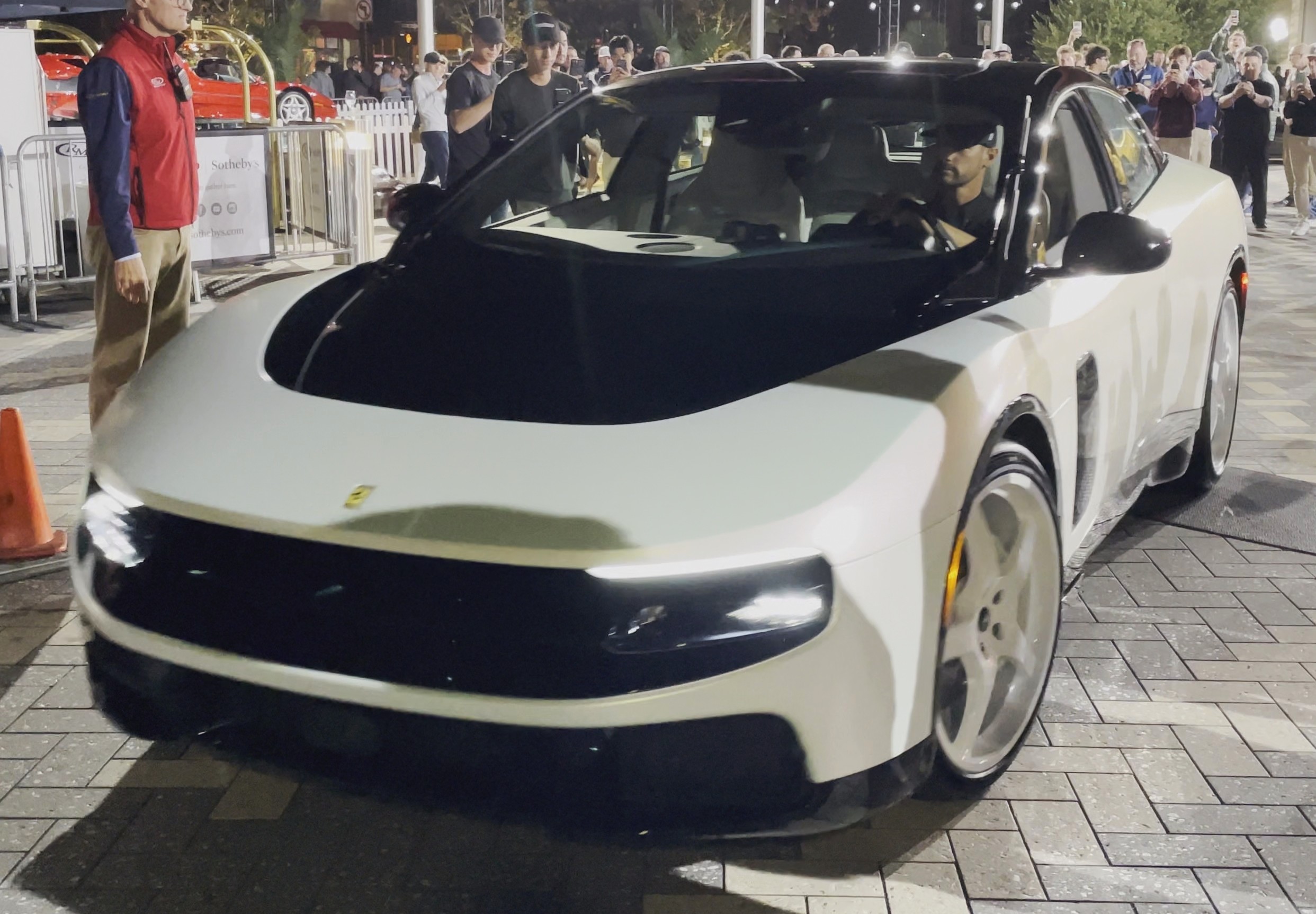
On 25 May 2026 Ferrari unveiled the Luce in Rome, and the market answered before the first customer took delivery. Shares fell about 8.4 percent the next day. Former CEO Luca di Montezemolo warned that a myth was being destroyed. Memes compared the car to a Multipla. The Guardian called the design divisive. Dezeen asked on air why everyone seemed to hate the new electric Ferrari.
That reaction was not about kilowatts. It was about recognition. For the first time in living memory, a production Ferrari did not look like a Ferrari in the way people mean the word. They mean a body that feels alive, curved, slightly improper, and impossible to confuse with a consumer gadget.
This essay holds a hard line. The Luce is an engineering achievement and a cultural failure. Jony Ive and Marc Newson’s LoveFrom studio designed a coherent machine from the outside in. They did not design a Ferrari. They designed an expensive Silicon Valley object that borrowed a prancing horse.
What Ive actually did
LoveFrom is not a styling consultancy that sketches a nose and leaves. Ferrari says the collective was given autonomy to set the design direction from the start, shaping exterior, interior, and interface as one system. Flavio Manzoni, Ferrari’s chief design officer, called the brief deliberately disruptive. Centro Stile would not invent the first pure electric language alone. An outside pencil would.
After roughly six months in San Francisco, LoveFrom presented a finished proposal. Manzoni has said the package was unusually coherent. Body, cabin, and interface arrived as a single idea. Ferrari then placed a small Centro Stile group beside them so the concept could be built without being rewritten.
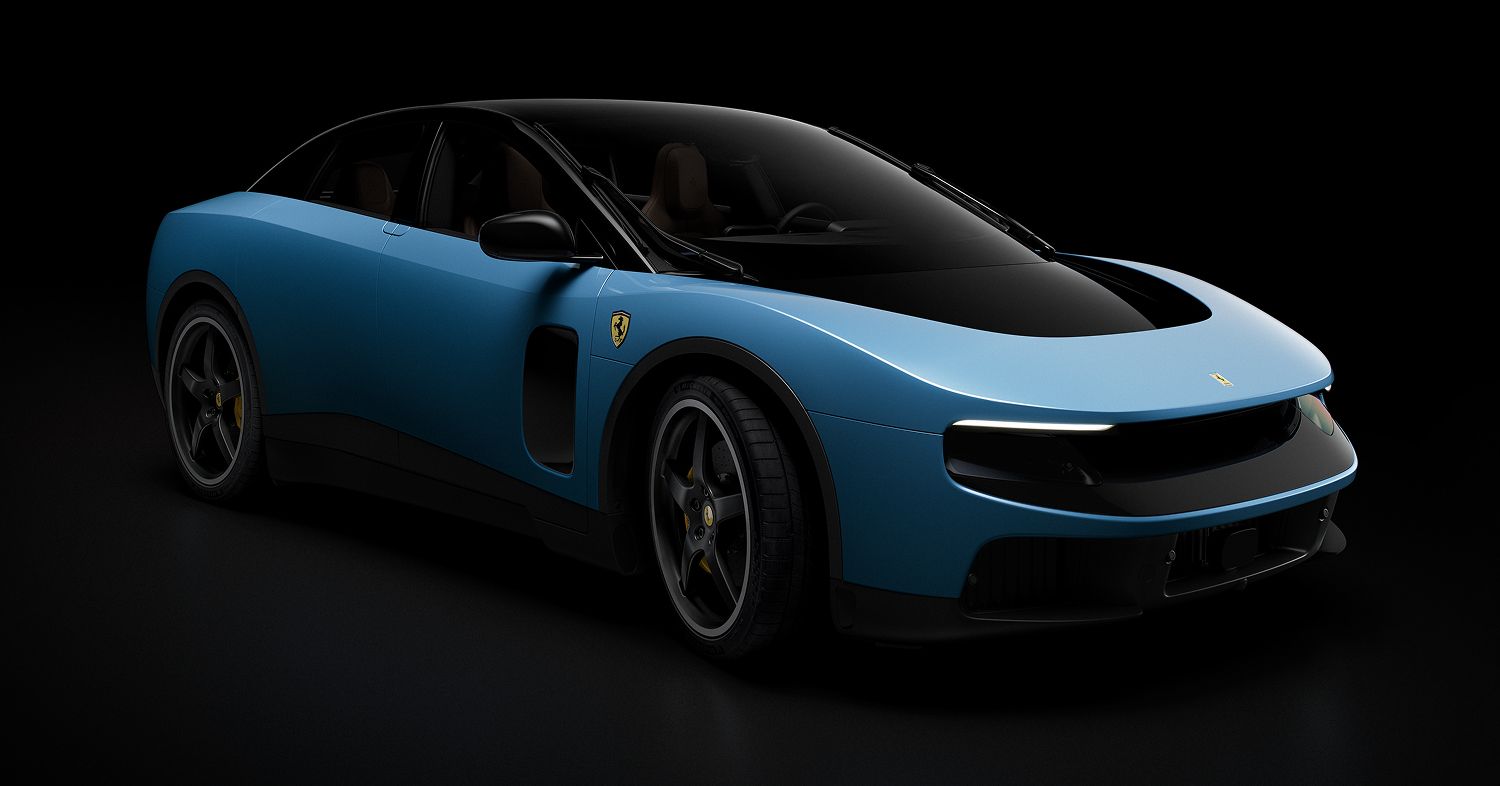
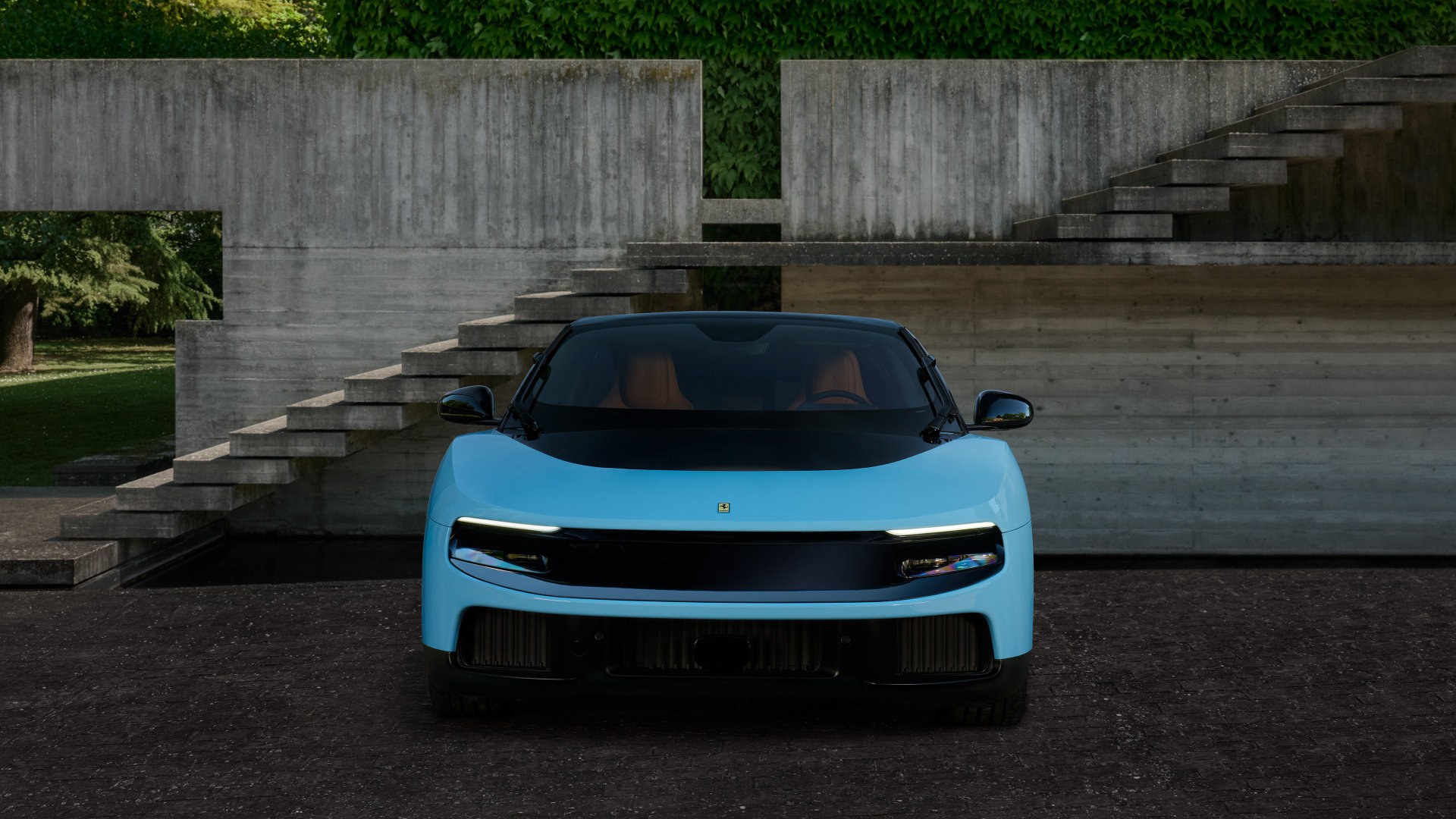
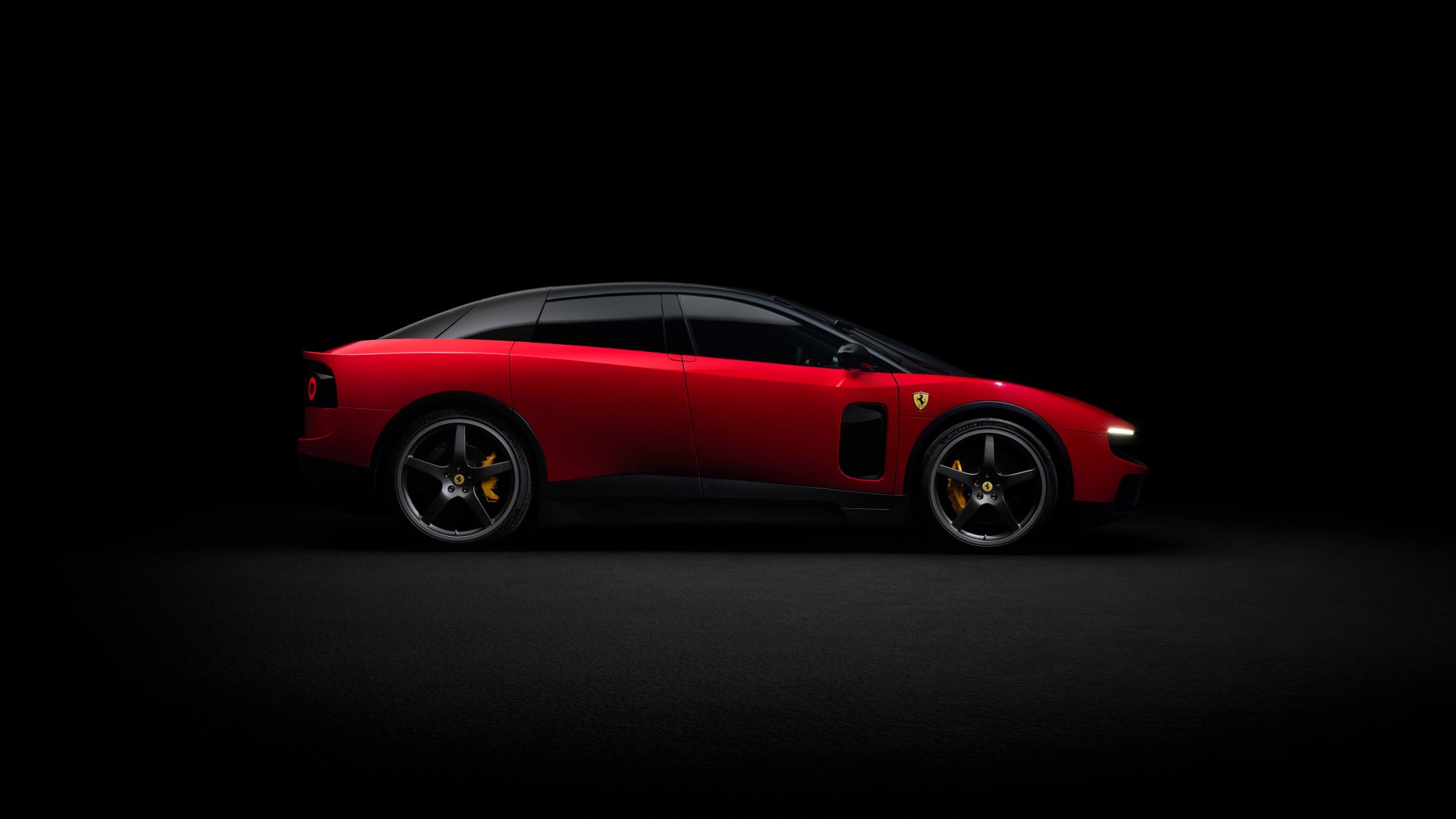
What rolled out of that process is easy to picture even without a brochure. The Luce is a five-door, five-seat liftback on a dedicated electric platform. Its cabin sits under a glass-forward “glass house,” with aero wings that seem to float around the shell. Corning glass becomes a primary cabin surface. Physical aluminum switches replace the phone-like touch wall that most electric cars treat as destiny. OLED panels from Samsung Display sit in the cabin. The key is Gorilla Glass with an E Ink face. The wheels are staggered at 23 inches in front and 24 in the rear, the largest set Ferrari has fitted to a series car.
Ive’s public remarks still sound like Apple’s old creed. Remove clutter. Chase inevitability. Distrust the assumption that electric power must mean a digital cabin. On that last point he is right. A multi-touch slab is not fate. The trouble sits elsewhere. Cutting cognitive load is not the same as understanding desire.
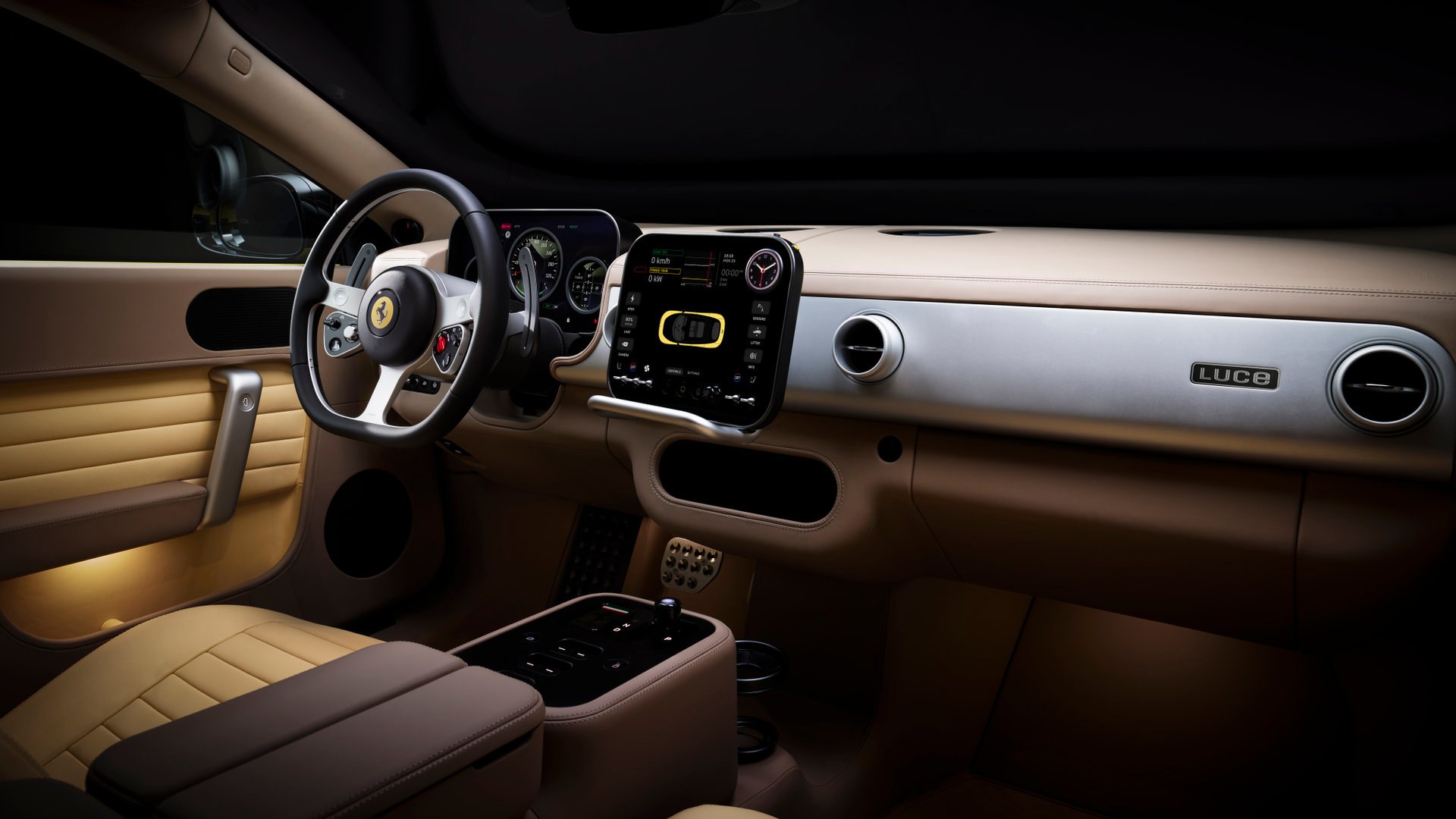
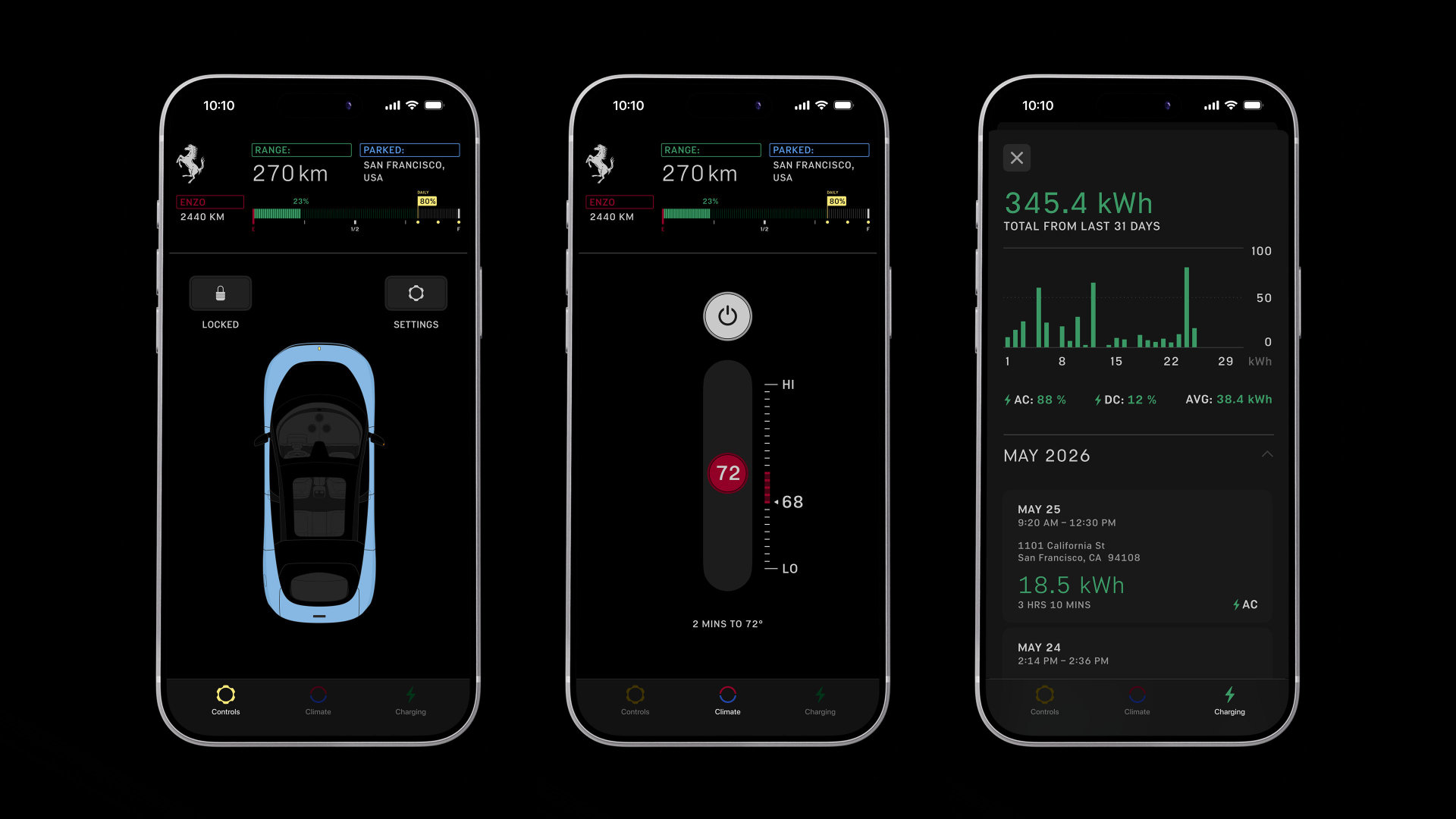
The numbers tell the product story as clearly as the pictures. The Luce stretches 5,026 mm long, nearly two meters wide, and 1,544 mm tall, on a 2,961 mm wheelbase. It weighs 2,260 kg at the kerb. Four motors deliver 1,035 horsepower. In Italy it starts near €550,000. Deliveries were planned for late 2026. It is Ferrari’s first production electric car, its second four-door after the Purosangue era of expansion, and its first five-seater.
In volume and mission it sits closer to a luxury executive car than to a mid-engine predator. That choice alone is not heresy. Brands evolve. The heresy begins when the form still claims the old myth while the body language has been replaced by high-tech purity.
To see where the designer went wrong, and what the new model actually broke, we have to leave Silicon Valley for a moment.
A look into history
The mistake of Luce is not that it is electric, tall, or practical. The mistake is that it forgot what Ferrari was built to mean. That meaning did not start in a San Francisco studio. It started in Maranello.
Scuderia Ferrari begins in 1929 as a racing operation. Road cars arrive later, in 1947, not as lifestyle products but as a way to fund racing. Enzo Ferrari’s public myth was never “mobility.” It was winning, obsession, and a factory that behaved more like an atelier under a dictator than like a Detroit plant.
The 125 S and the early competition cars set a pattern. The machine is a weapon that happens to become beautiful when it wins. Coachbuilders around Modena and Turin then translated that aggression into road sculpture. Pininfarina’s long relationship with Ferrari purified lines that could survive decades. Scaglietti’s panel beaters spoke of smooth sections the way a tailor speaks of a dress. No steps. No awkward peaks. Air that does not rustle.
That history is the charge sheet against Luce. Ferrari’s brand equity is not the equity of an Italian tech company that happens to make fast transport. The equity is a visual and emotional contract. The car should look as if it wants something from you. Ive designed calm. Ferrari had sold appetite.
Who was supposed to draw it, and why it had to be red
Luce also forgot two quieter traditions that sit under every mythic photograph of a Ferrari. Who is allowed to invent the body. And what color that body is supposed to wear when the world first meets it.
For most of Ferrari’s life, the silhouette was not invented in a consumer-electronics studio. It was negotiated in Italy. Pininfarina’s long partnership with Maranello turned racing aggression into road sculpture that could still look expensive twenty years later. Sergio Scaglietti’s workshop beat aluminum into continuous skin. Later, Centro Stile in Maranello, under Flavio Manzoni, kept the authorship inside the factory even when the cars got hybrid systems and taller packages. The pencil could travel, but the custody of “Ferrari” stayed Italian. LoveFrom broke that custody. Six months in San Francisco produced a finished formal religion. Centro Stile was invited afterward to help build it, not to author it. That is not collaboration in the Pininfarina sense. That is Maranello becoming a manufacturer of someone else’s inevitability.
The second tradition is red. Not red as a marketing preference. Red as a national racing inheritance that Ferrari made proprietary through stubbornness.
In the early twentieth century, international motor racing assigned countries identifying colors so spectators could tell teams apart without reading tiny badges. Italy took red, rosso corsa. The popular origin story goes back to 1907, when Prince Scipione Borghese won the Peking to Paris endurance challenge in a scarlet Italian Itala. After that heroic win, Italian manufacturers grabbed the shade as a badge of competence. Alfa Romeo, Maserati, Lancia, and later Ferrari painted competition cars in racing red because the color already meant Italy on a starting grid.
Ferrari then did something the rest of Formula 1 mostly abandoned. When sponsorship liveries arrived in the late 1960s, other teams became rolling billboards. Ferrari stayed red. The factory’s own magazine still treats that choice as identity work. The first Prancing Horse cars, including the 125 S, wore a dark burgundy Italian racing hue. Road cars inherited the association. By the early 1990s, about 85 percent of Ferraris left Maranello in red. Even today, traditional reds still account for roughly half of client orders, with Rosso Corsa as the shade most people mean when they say “Ferrari red.”
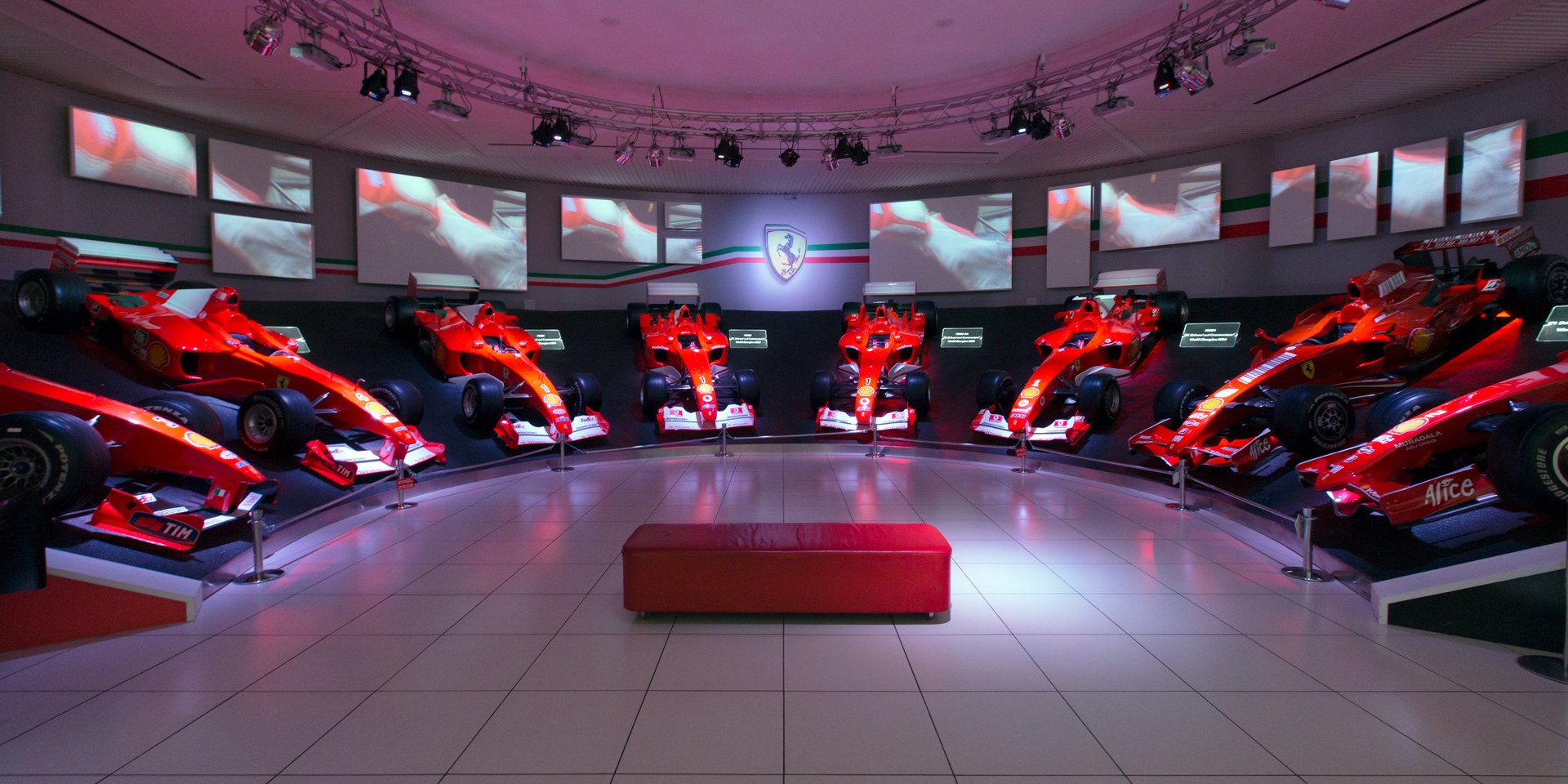
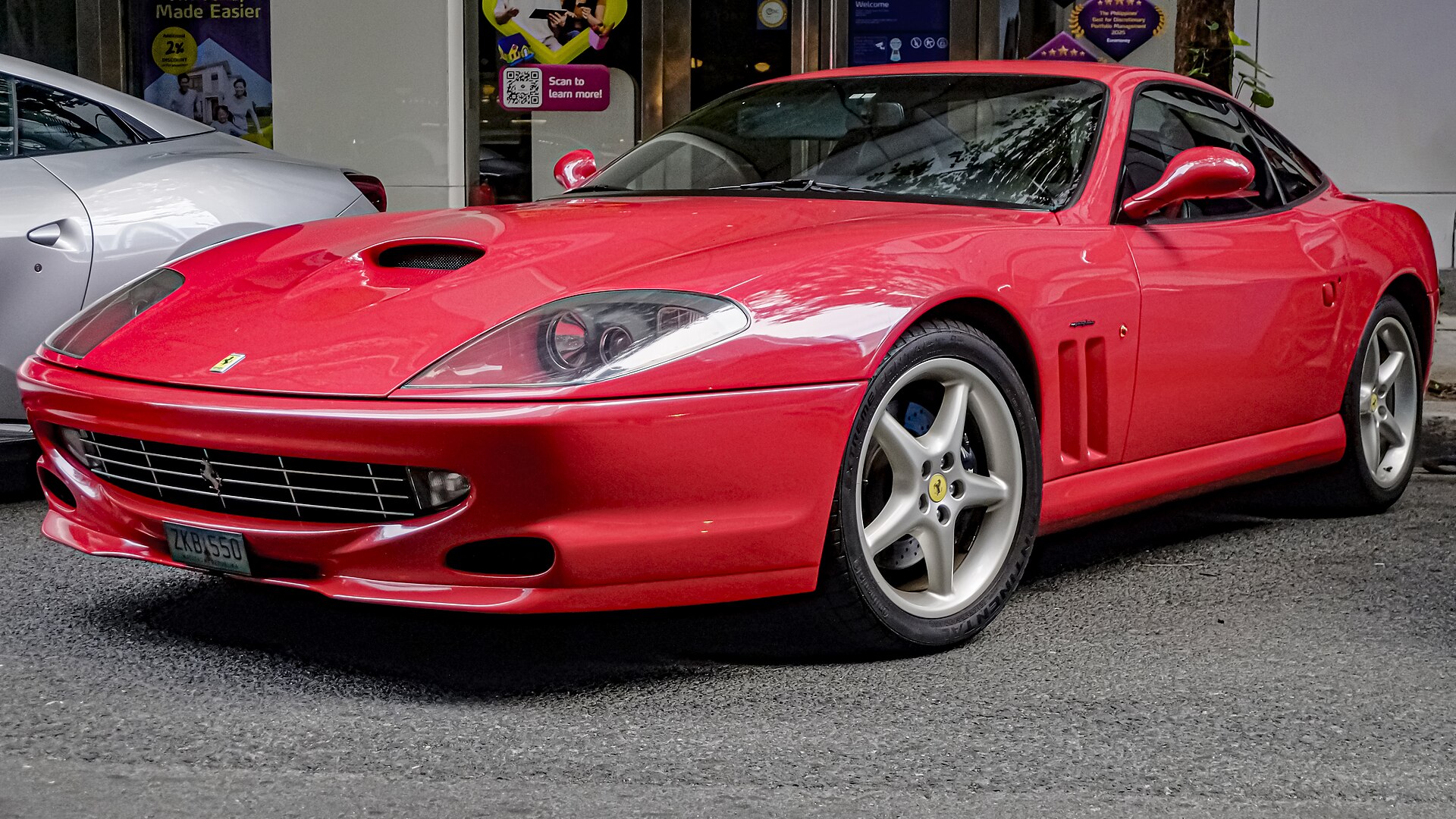
So when a new Ferrari is launched, red is not one swatch among thirty-five equals. It is the default myth. Luce can be ordered in Rosso Corsa, Rosso Dino, Rosso Fiammante, and a long menu of other paints. That is not the point. The launch language treated color the way a phone launch treats finishes. Special new yellows. Cool silvers. A curated five-car color story aimed at progressive luxury. The car can wear red. The design did not behave as if red were sacred skin. It behaved as if red were an option in a configurator, equal to Arctic white and launch yellow invented for the project.
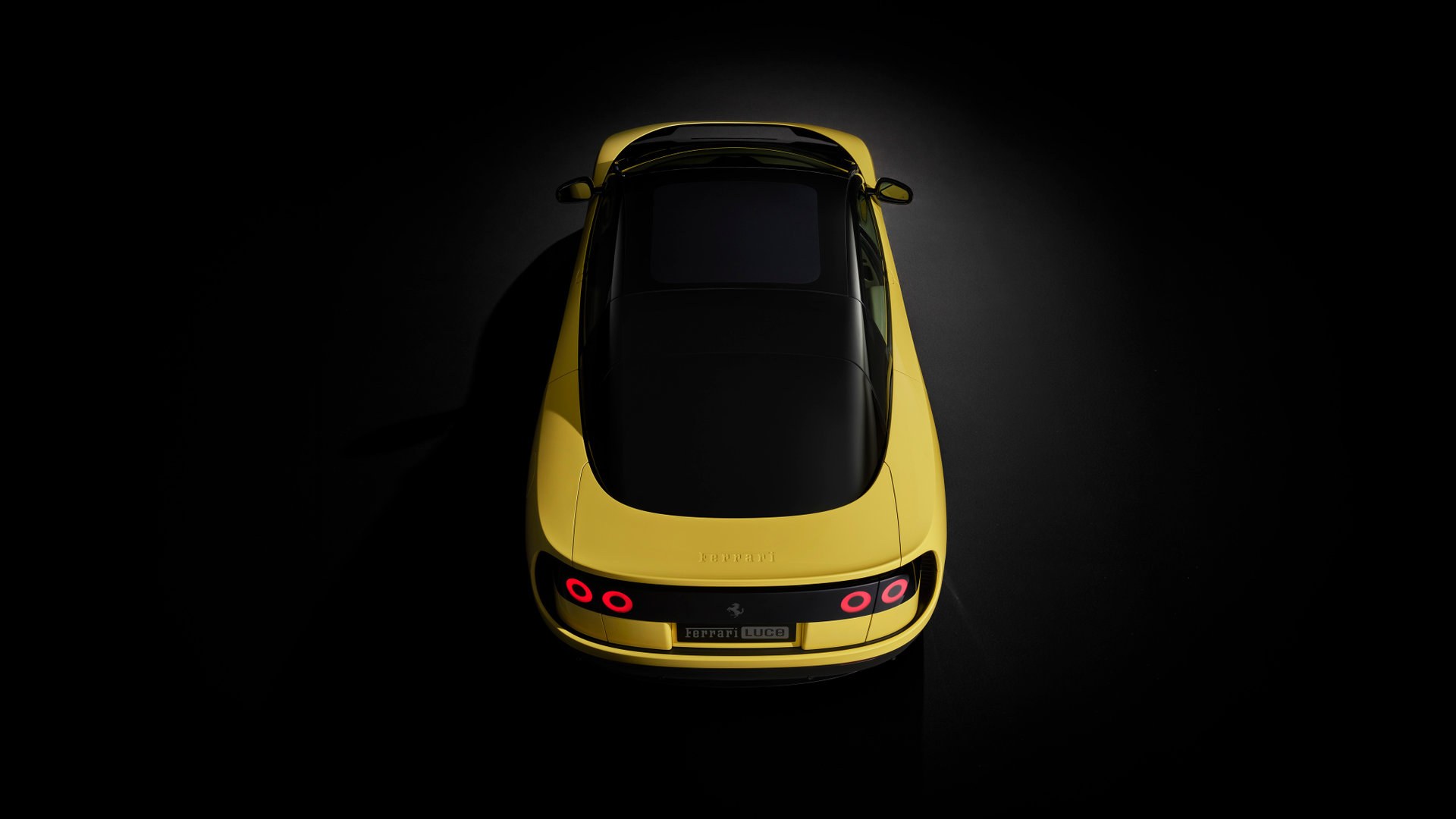
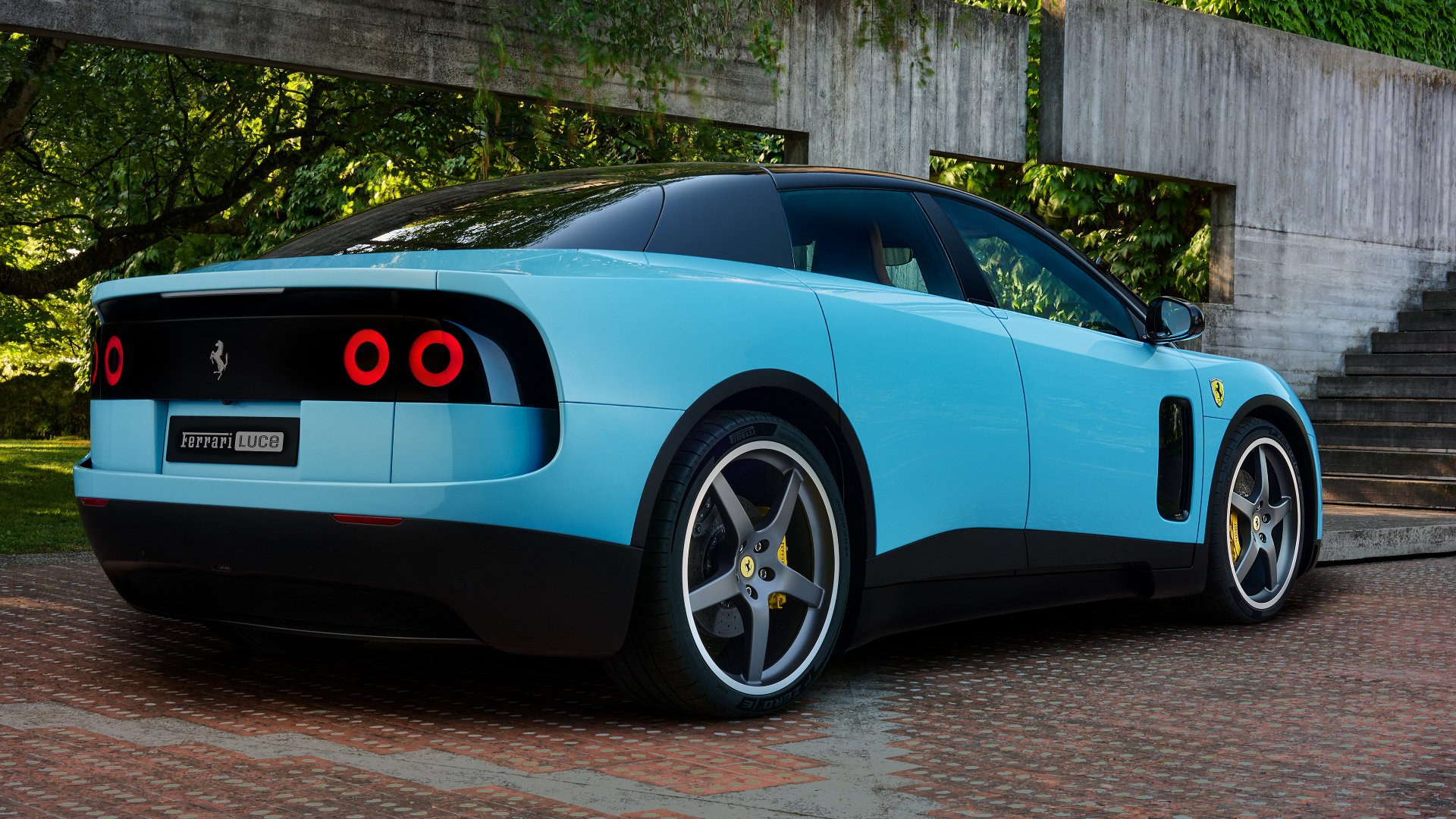
A Ferrari drawn outside the Italian custody chain, and sold first as a palette exercise, is already halfway to becoming a device. The curves argument and the red argument are the same argument. Tradition is not nostalgia. It is the set of constraints that keep the object recognizable when the powertrain changes.
Why the female body became Ferrari’s unofficial philosophy
Here the popular story and the archival record diverge, and the divergence helps.
Enzo Ferrari was not the soft romantic Instagram nostalgia wants him to be. In a 1966 New Yorker profile he said that when you marry an idea it becomes beautiful, then added, characteristically, that it was not like a woman. He could be harsh, absolutist, and allergic to sentimentality.
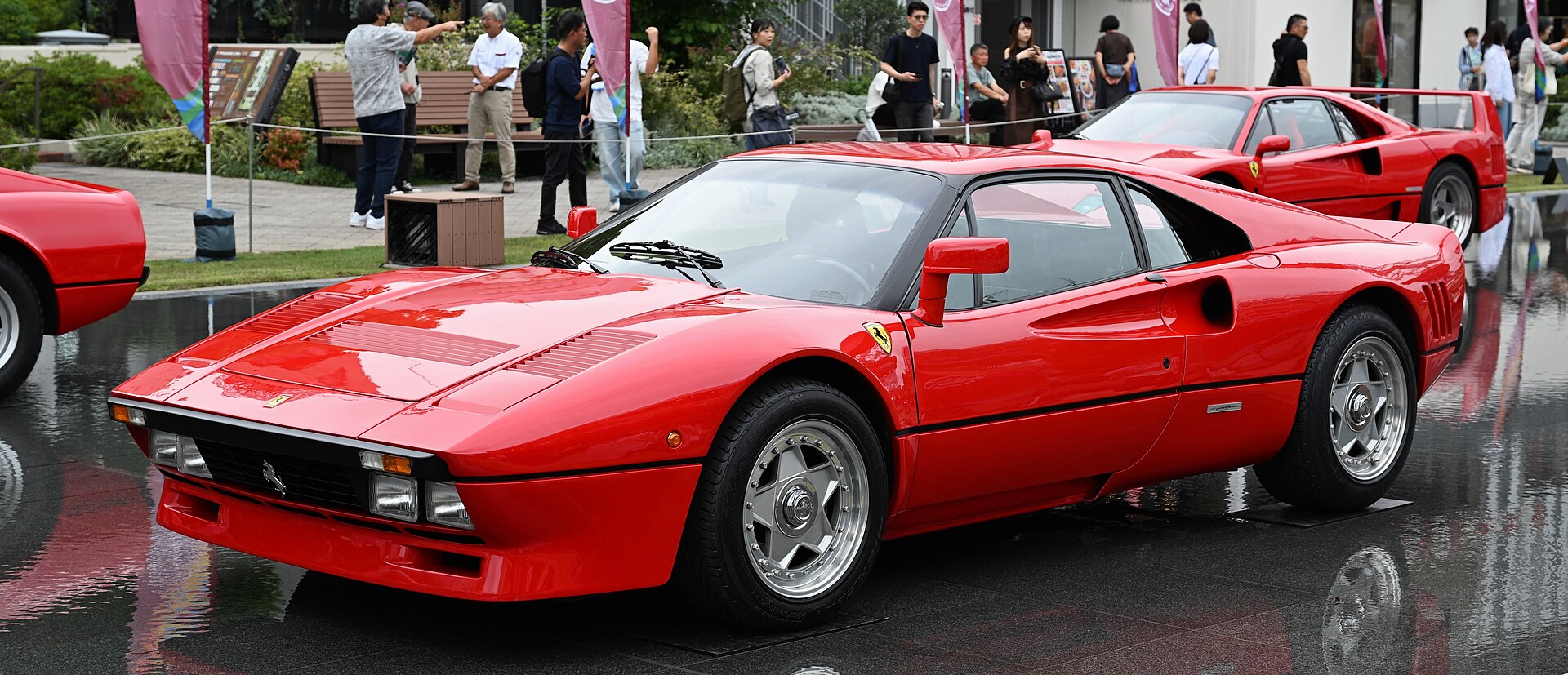
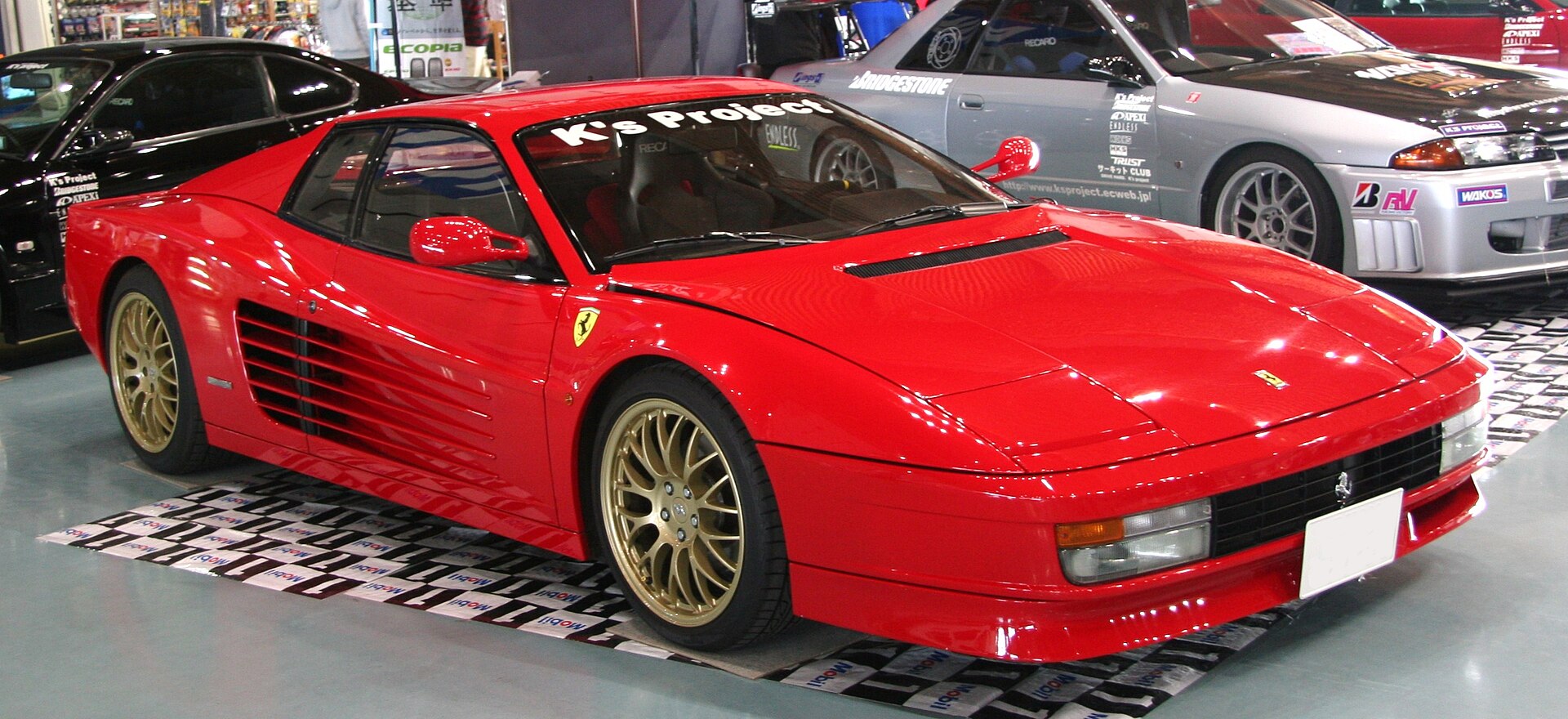
Yet the culture around his cars kept returning to the body. Coachbuilders compared surfaces to hips and shoulders. Gian Carlo Guerra, who worked the metal of legendary Ferraris, said a car is a little like a woman and that he disliked pointy women. Smooth sections were taste and aerodynamics at once. Luca di Montezemolo, decades later, sold the brand with an explicit metaphor. Ferrari, he said, is like a woman you desire and wait for. Jackie Stewart described driving at the limit with the intimacy of a physical relationship. From the Testarossa to the 288 GTO, Pininfarina-era commentary treated sensual curvature as the Italian difference from Anglo-German severity.
So the “female body” claim is not a single Enzo quote for a poster. It is a design tradition that you can still read on a side view. The waist of the car is the pinched midsection where light narrows. The hip is the swell over the rear arch, the place where mass turns into invitation. The shoulder is the front fender that rises and softens before the glass. The silhouette is not a box with wheels. It is a continuous S-curve that the eye follows the way it follows a figure walking away.
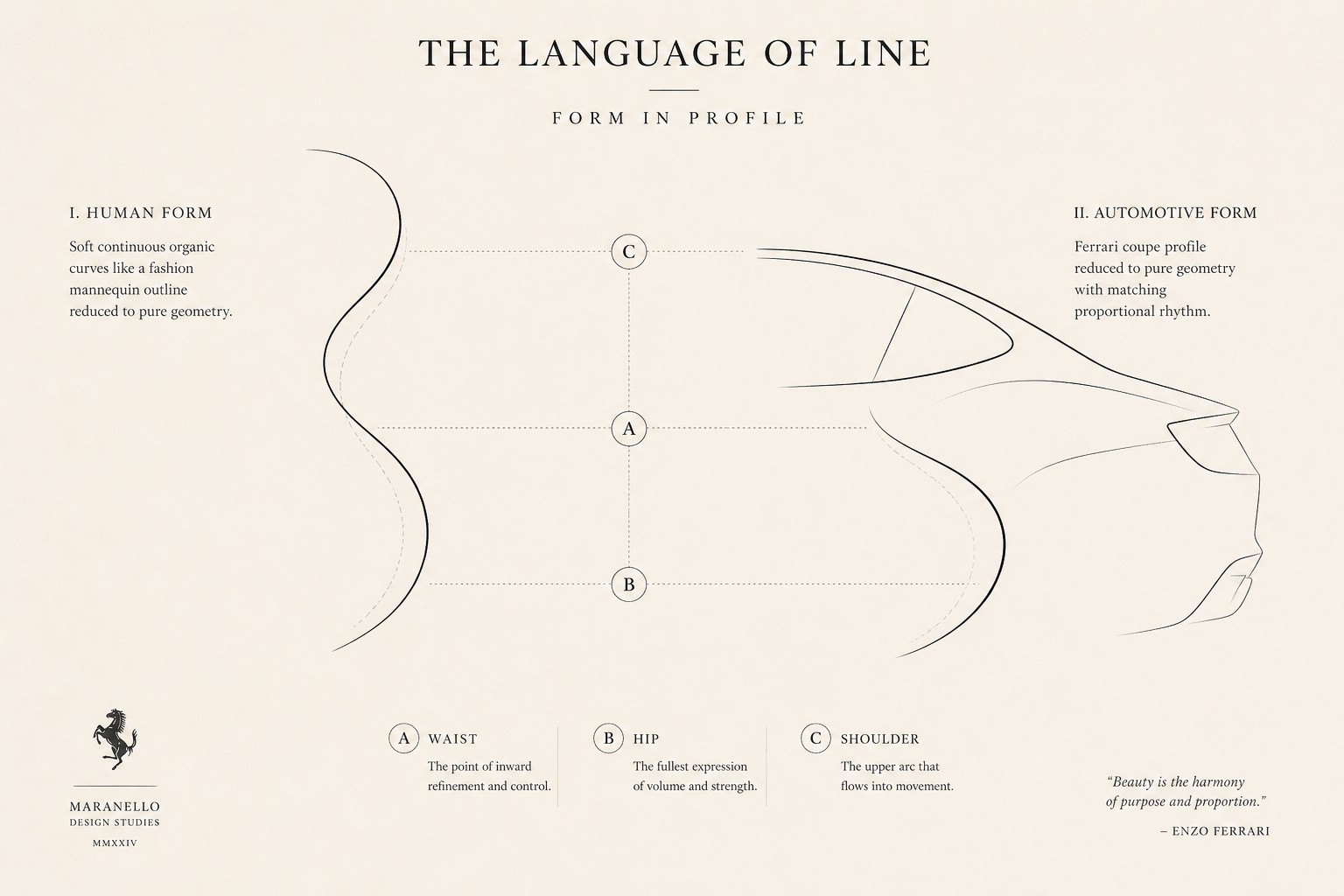
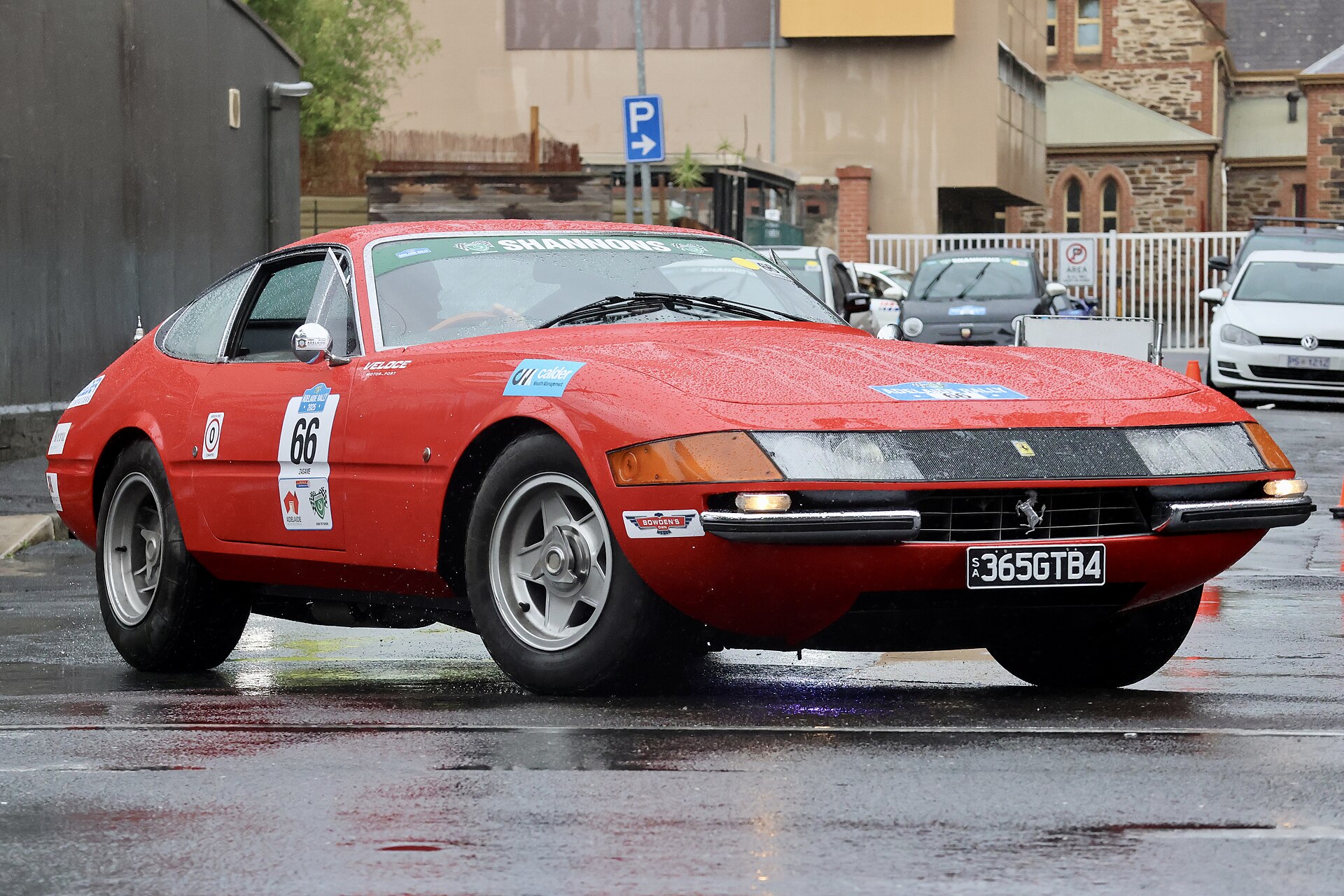
Look at a Daytona in profile and the mapping is almost unfairly clear. Long hood as the stretch of the torso. Cabin set back like a head held with composure. Rear haunch that carries weight the way a hip carries weight. The 288 GTO makes the same argument with more aggression. The Testarossa, even when the 1980s flattened its flanks into geometry, still kept that hip and that predatory stance. These are not soft cars. They are bodies that know they are being watched.
Class-A surfaces make light travel in unbroken arcs. Hips swell over the rear arches. Waists cinch. Volumes feel mammalian rather than extruded. Form follows emotion, and then physics is forced to negotiate with desire.
Why men name cars and why that is not a joke about sex
Every man who cares about cars chooses by image before he chooses by spreadsheet. The silhouette arrives first. Specs come later, if they come at all. That is why the same person can reject a faster, cheaper machine and pay more for a shape that feels right. He is not buying transport. He is recognizing a figure.
There are old jokes about this. Men give cars female names. They wash them on Sundays. They speak about them with a tenderness that would sound absurd applied to a toaster. The joke is easy to mock. The truth under the joke is older than Instagram memes. The car is treated as if it had a temperament. You learn its moods. You listen to it. You wait for it. You protect the paint because the paint is skin.
This is not the personification of sex in the cheap sense. It is the image of passion and faith. The belief that what you drive is not only a mechanism, but a living organism. Metal, rubber, and glass arranged so carefully that the whole thing seems to breathe. When that faith works, driving becomes a kind of orgasm. Not because the cabin is a bedroom, but because the body of the car and the body of the driver enter the same rhythm. Speed, fear, trust, and release arrive together. You do not analyze it in the moment. You feel it.
Ferrari sold that feeling better than almost any brand on earth. The red car was never only fast. It was a figure you could fall for. That is why Luce’s “purity” feels like a category error. LoveFrom chased closed, polished, almost appliance-like volumes and a cross-contamination from high-tech industrial design. Manzoni himself named that contamination as a feature. For a phone or a speaker, purity is virtue. For Ferrari, purity without erotic tension is a corpse with perfect seams. An organism without a pulse.
A short museum of curves that worked
Set the Luce’s glass shell beside the cars that taught the world what a Ferrari is. Read each one as a body, not as a product shot.
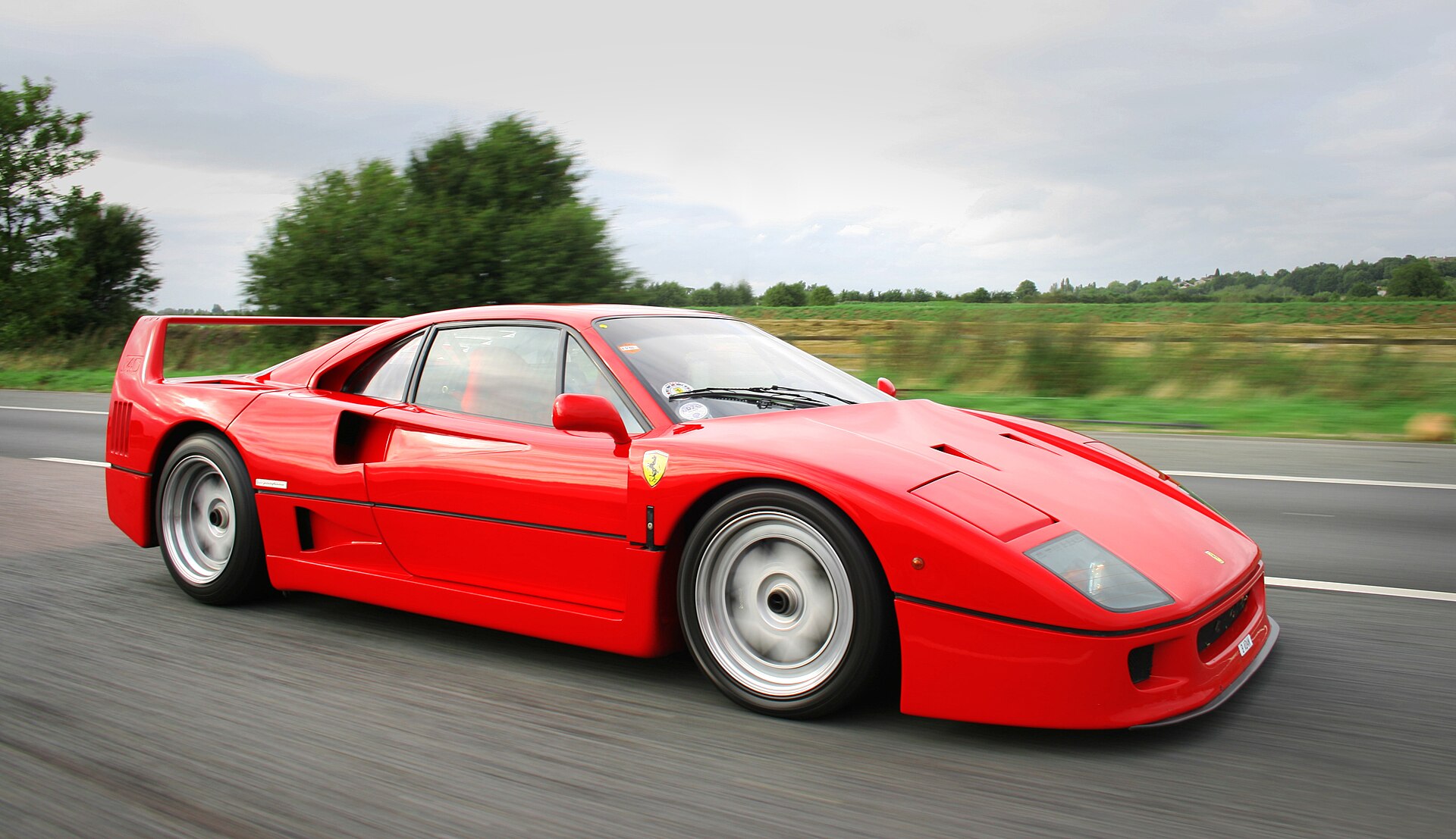
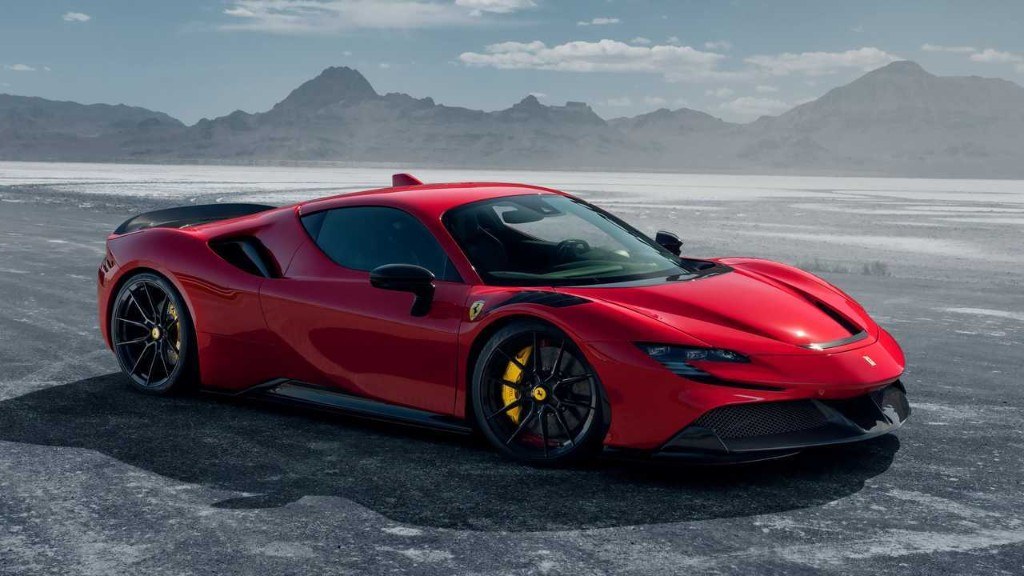
Even the Purosangue, Ferrari’s most controversial recent step into tall practicality, kept a sense of animal mass and Ferrari surface drama. It stretched the brand. It did not replace the brand’s body with a glass appliance.
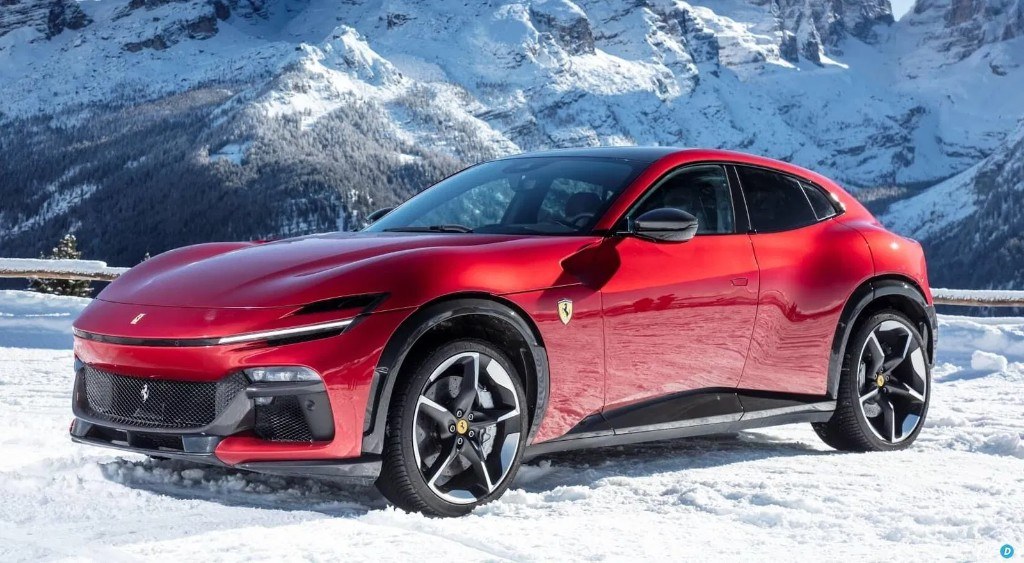
Luce’s problem is not that it has four doors. The problem is that its primary formal idea is uncompromised glass purity rather than a body in heat. One is a museum of materials. The other is a myth you can name, wash, and love.
American production culture and the aesthetics of bulk
“Americanism” here is not a passport insult. It is a production philosophy built on volume, package efficiency, crash structure, cup holders, and a tolerance for visual brutality if the spreadsheet works. The Hummer H2 is an extreme cartoon of that ethic. Escalades, Suburbans, Navigators, and full-size pickups sell the same sermon at different prices. Mass becomes status. Surface becomes armor. Sensuality is optional.
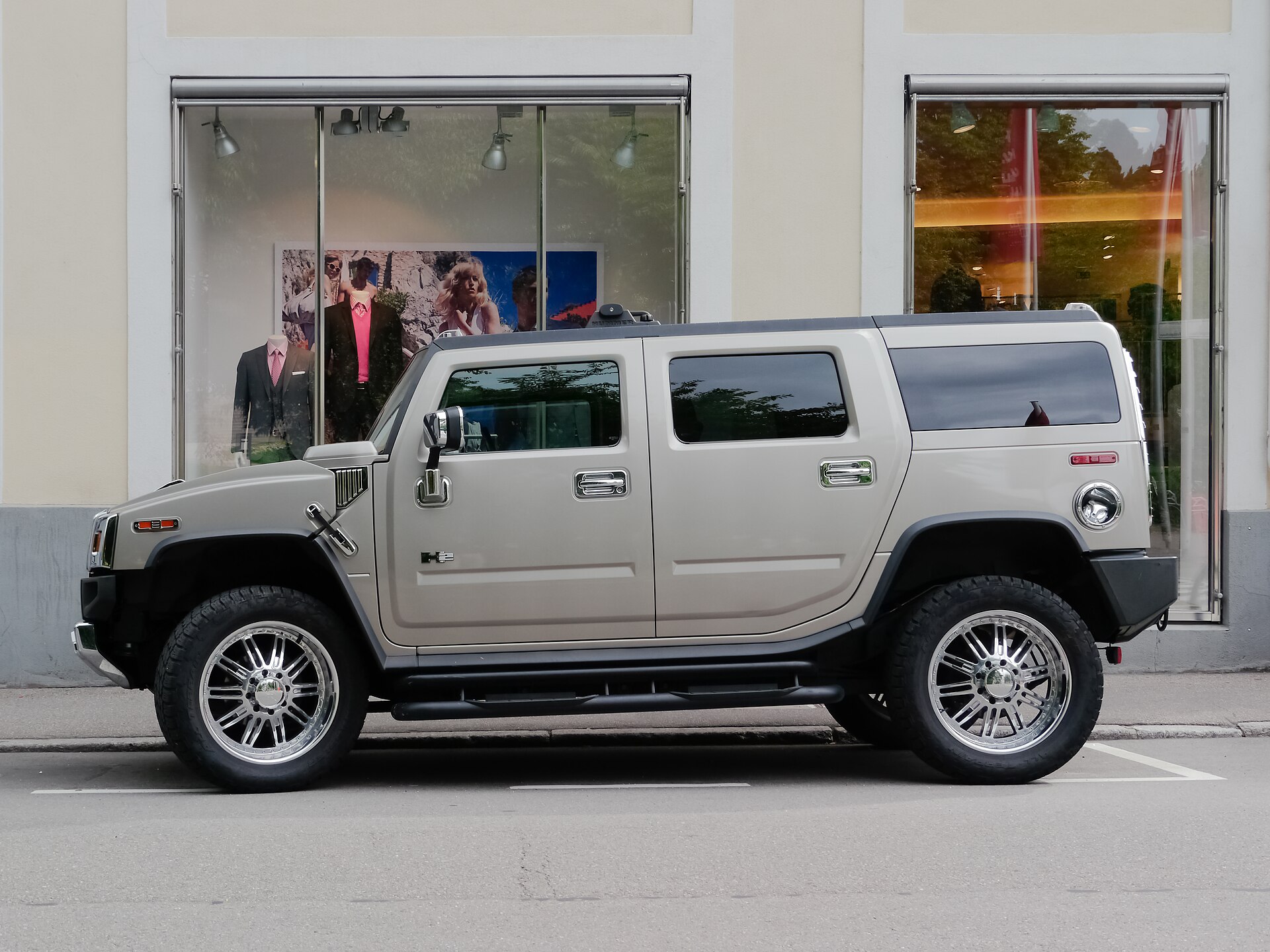
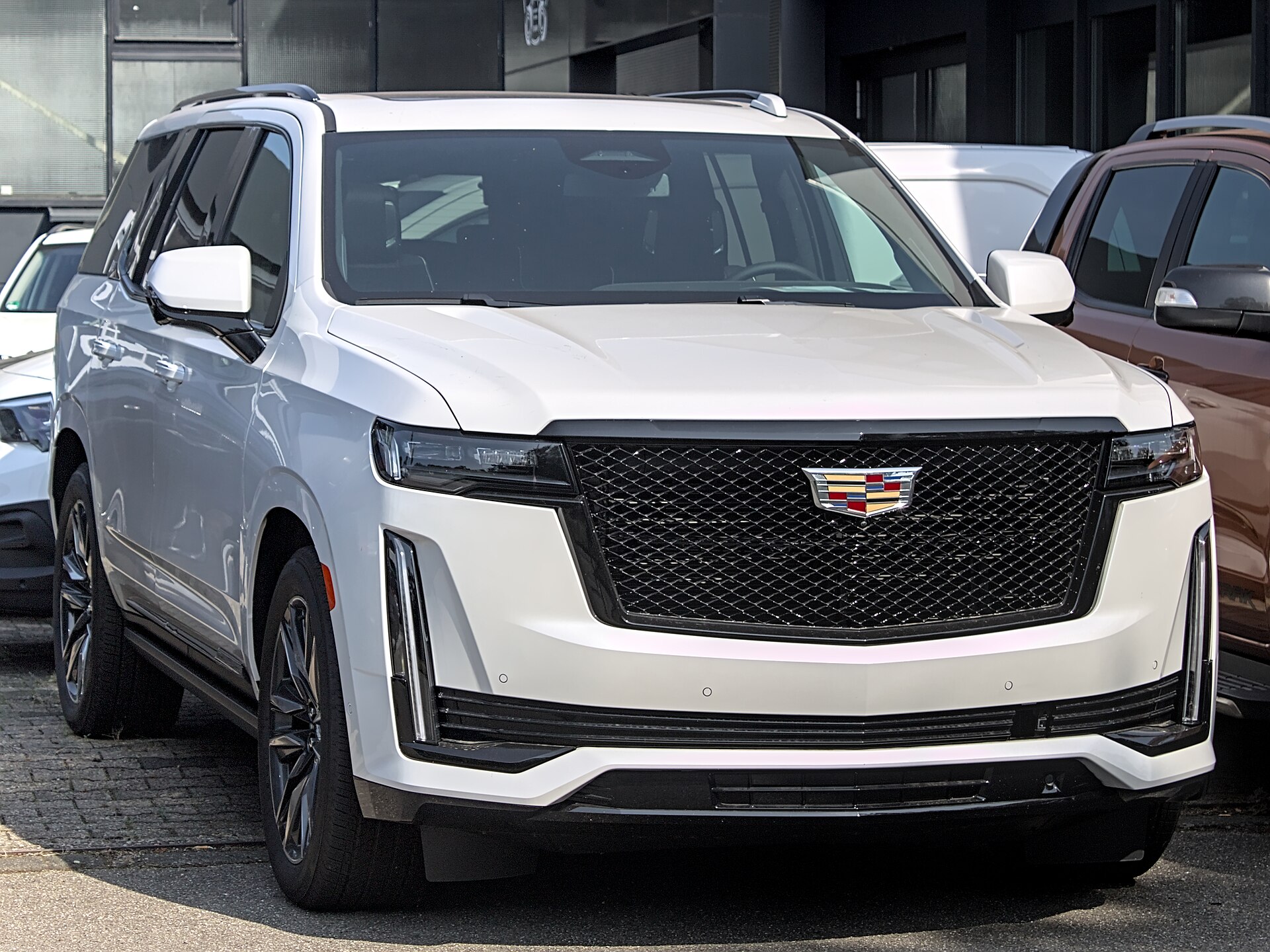
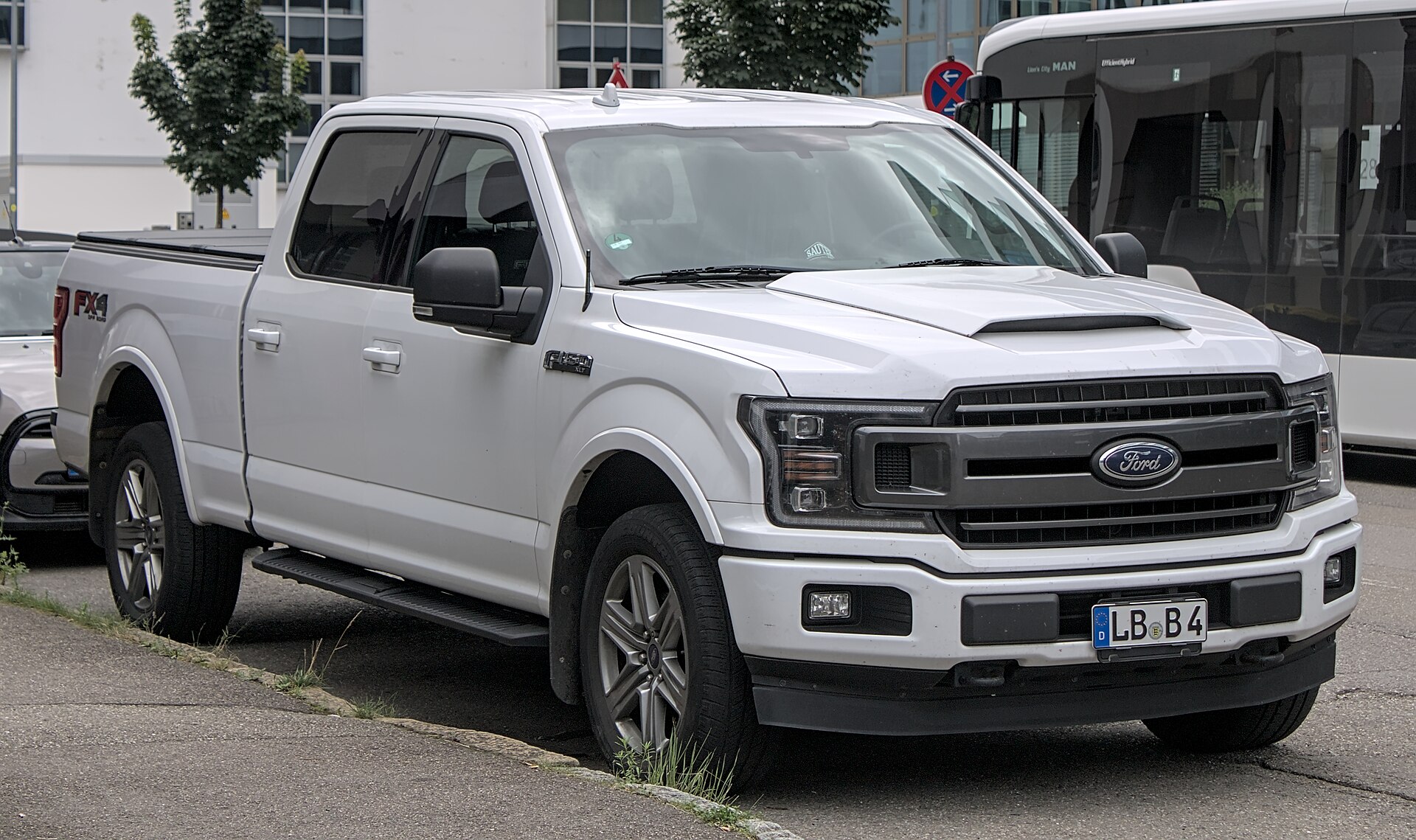
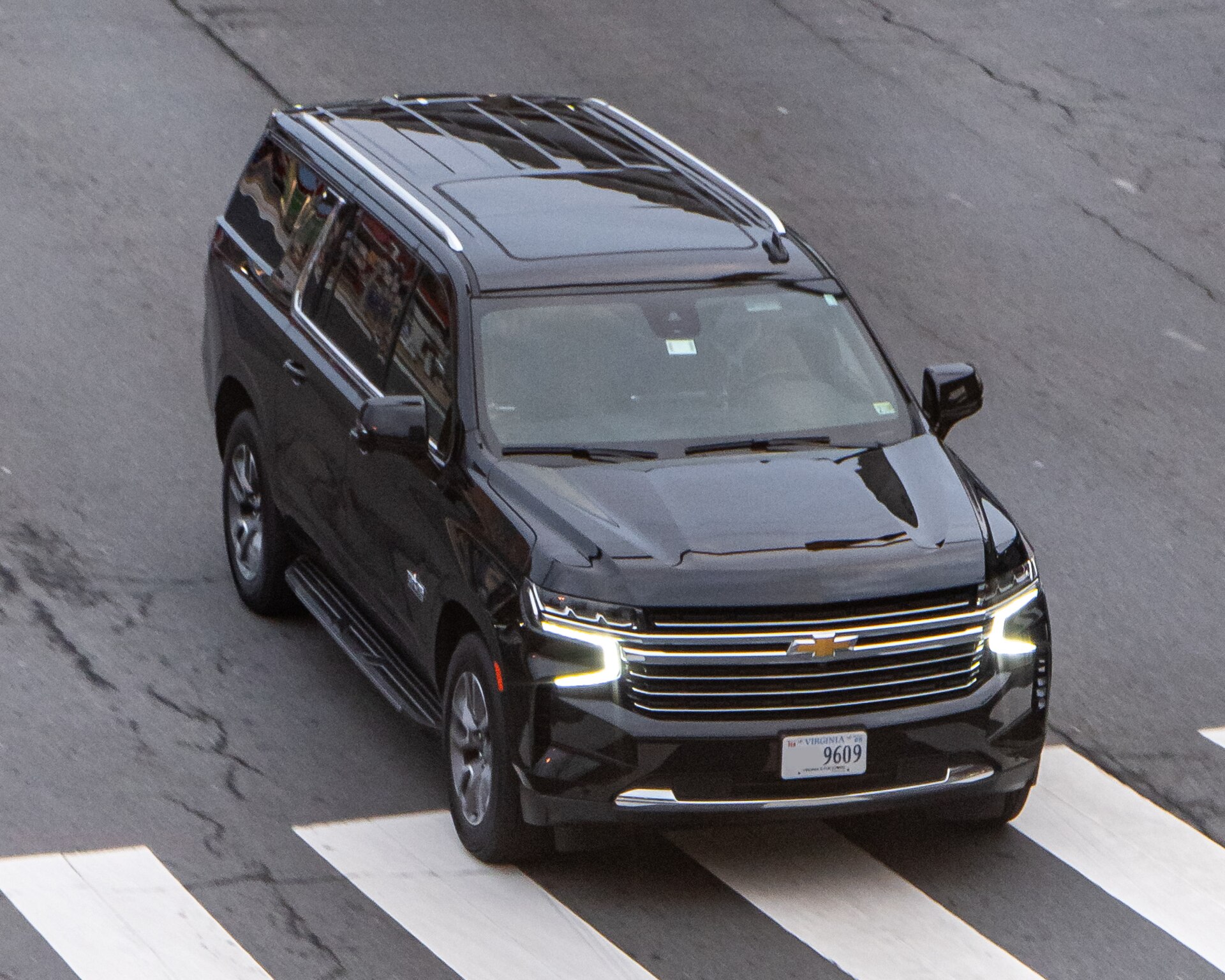
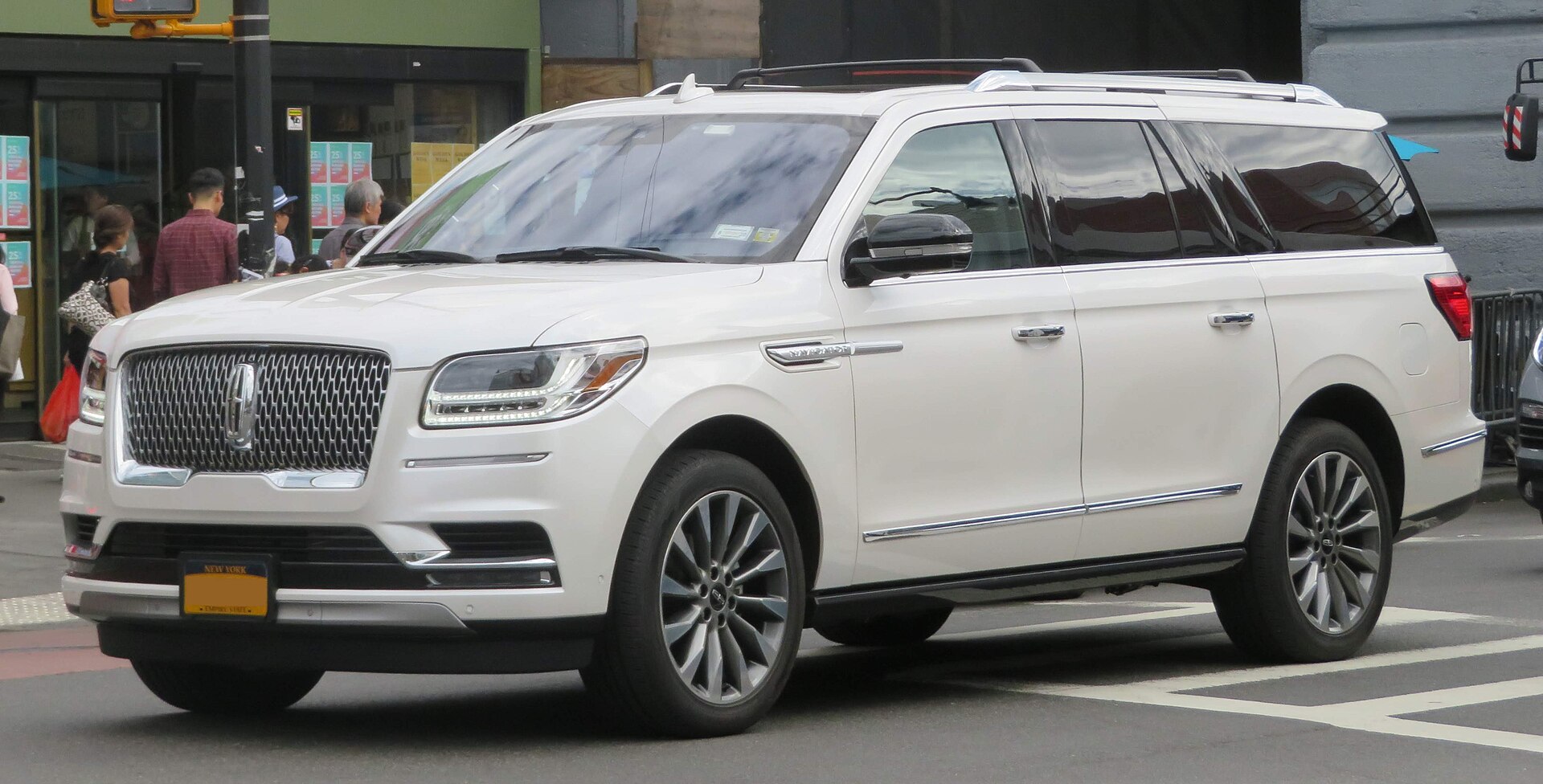
Silicon Valley industrial design is a cousin of that culture, not a twin. It hates chrome clutter and loves inevitability. It is excellent at making objects disappear into a lifestyle. Ferrari’s historic job was the opposite. A Ferrari was meant to refuse disappearance. A Ferrari that looks inevitable in the Ive sense has already lost. Inevitability belongs to phones. Ferraris should look slightly impossible.
LoveFrom’s five-year collaboration with Maranello imported the wrong virtue. They imported calm. For most of its life Ferrari sold controlled violence and seduction. When you import calm at €550,000, customers hear a different company speaking.
That is also why the “American” critique lands even though the designers are British and Australian and the factory is Italian. The cultural export is Cupertino process. Reduce. Unify. Make the object feel as if it could only be this way. Maranello’s process was never only reduction. It was sculpture negotiating with engines, then engines negotiating with sculpture.
The math behind a fast car that still does not feel Ferrari-fast
Marketing will say 0–100 km/h in 2.5 seconds and more than 310 km/h. Those numbers are real enough to print. They are also the wrong frame for what Ferrari speed used to mean.
Specific power is the simplest honesty check. The Luce makes about 0.46 horsepower per kilogram, or roughly 458 hp per tonne. An SF90 Stradale, with about 1,000 horsepower on a car in the mid-1,500 kg class, sits near 0.64 hp/kg. A 296 GTB, with 830 horsepower on roughly 1,470 kg dry, sits near 0.56 hp/kg.
Luce carries roughly 690 kg more than an SF90-class sports car. That is not a rounding error. That is another entire lightweight sports car riding along as a passenger.
Newton is not impressed by brand decks. Acceleration scales with force over mass. Instant electric torque hides the problem in a straight-line launch, which is why 2.5 seconds still looks “Ferrari” on a poster. The lie appears after the Instagram number.
In corners, lateral grip fights mass. More kilos mean more tire load, more heat, more understeer risk, and more work for the active systems. Software can mask. It cannot repeal. In braking, kinetic energy is half of mass times velocity squared. At the same speed, 2,260 kg stores about 44 percent more energy than 1,570 kg. Pads and rotors must eat that difference again and again. In direction changes, yaw inertia grows with mass distribution. A long five-meter executive electric car with a structural 122 kWh pack is a different animal from a mid-engine two-seater, even with four-wheel steering and torque vectoring. At the top end, 310-plus km/h is strong for a five-seater and modest beside hybrid flagships that still aim higher while weighing less. Power fights drag at peak speed, but the Ferrari feeling was never only peak speed. It was the rate at which the car tightens your chest between apexes.
There is a second mathematical embarrassment in the name. Luce means light. The car weighs 2.26 tonnes. The poetry is doing overtime.
Ferrari answers with technology. Torque Shift Engagement paddles try to fake progressive surge. An accelerometer-based “living” sound amplifies the motors. The vehicle control unit updates two hundred times per second. An 800-volt architecture supports 350 kW charging and about 529 km of WLTP range. All of that is serious engineering. None of it restores the lost power-to-weight ratio of a true sports Ferrari. You can amplify axle vibration into a soundtrack. You cannot amplify away 2,260 kg.
So when people say the new model “is not fast,” translate carefully. They do not always mean the stopwatch. They mean the car is fast the way a heavy electric sedan is fast. Launch-gun quick. Never light on its feet. For Ferrari, that distinction used to be the whole business.
What the market heard
The day-after stock drop hit hard. Milan-listed Ferrari fell about 8.4 percent. On the NYSE, RACE closed near 5 percent lower, from roughly $348 to about $330. Montezemolo’s fury is not proof that Luce will fail commercially. China allocations sold out quickly. Collectors already treat early chassis as auction theater. Brands can sell products that fans hate, especially when supply is rationed.
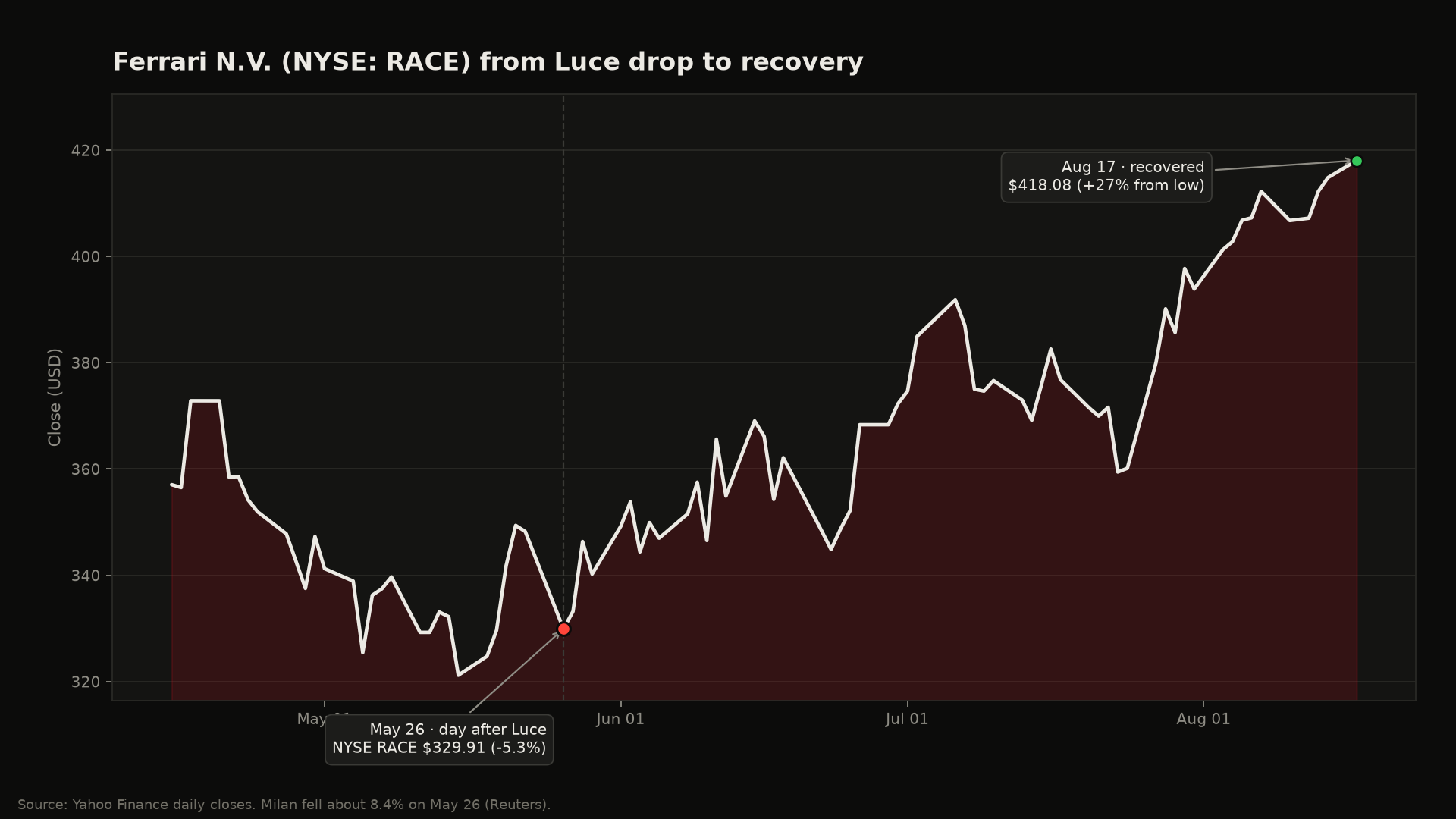
The panic did not last. Within two sessions the New York listing had clawed most of the loss back. By July, coverage was already writing that Ferrari had recovered from its Luce-unveil slump. By mid-August, RACE traded near $418, roughly 27 percent above the day-after low and about 20 percent above the close just before the reveal.
The market had reasons that had little to do with liking the car. Analysts framed the first selloff as classic “travel and arrive.” The stock had run hard into the unveil, so the news itself became an excuse to take profit. RBC told clients it was too early to be overly concerned, especially if limited volumes kept exclusivity intact and if new buyers, including in China, could absorb a shape core collectors hated. Citi reminded everyone that Ferrari’s earnings for the foreseeable future still ride on combustion and hybrid products, not on one polarizing electric five-seater. Design hate can bruise a multiple for a week. It does not rewrite the P&L overnight.
Then the operating story reasserted itself. Personalization demand came in stronger than management had modeled. Ferrari beat second-quarter expectations and raised full-year guidance. A bespoke Luce later sold for about $40 million in a charity auction, a grotesque collector theater that told investors scarcity still prints money even when Instagram is cruel. The machine can be culturally wrong and commercially rationed at the same time. Wall Street priced the second fact faster than enthusiasts forgave the first.
None of that rehabilitates the silhouette. It only proves the recognition contract and the financial contract are not the same document. The public still read the car as a device. The share price decided the brand could survive being misunderstood, as long as waitlists, margins, and ICE cash flow stayed intact.
If design can almost kill a business, it does it this way. Not by missing a trend, but by spending five years polishing the wrong religion. Ferrari’s religion was never minimalism. It was appetite given a chassis number. The stock rebound shows appetite can be postponed. It does not show appetite was restored.
Official images and film
The stills in this piece come from Ferrari’s public media and from historical photographs on Wikimedia Commons. The official moving-image record is open. Start with the Ferrari Luce product page and the full reveal film. The series Ferrari Luce Inside the Story walks the project from first idea to finished car in Episode 1, Episode 2 on design, Episode 3 on the build, and Episode 4 with Hamilton and Leclerc. Flavio Manzoni also speaks directly in a short film on the inspiration behind Luce. Ferrari’s corporate note on the Maranello chapter and the Media Centre hold further press stills and B-roll.
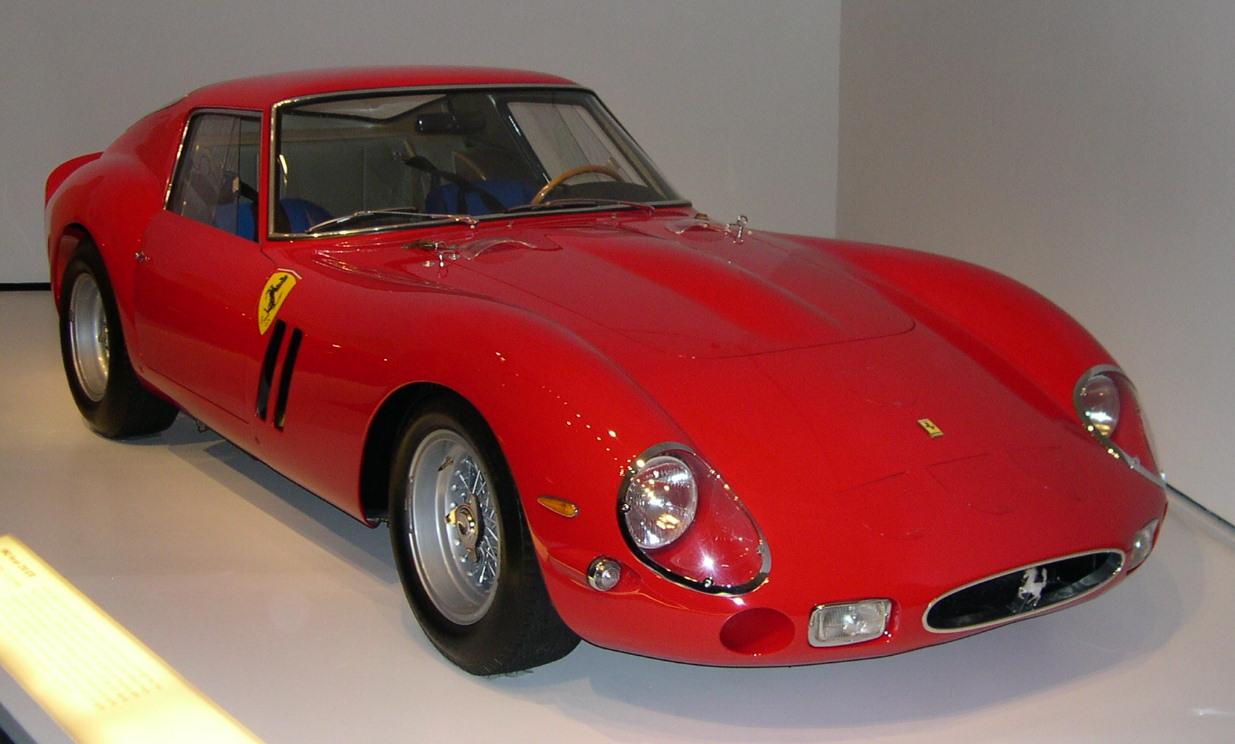
If you watch only one thing, watch Episode 2, then look at a 250 GTO. The gap between those two images is the whole argument.
How the car could have looked
Keep the brief. Keep the electric architecture, the five seats, the four doors, the 800-volt pack, even the tactile aluminum wheel. Change only the religion of the body.
A Ferrari-shaped Luce would not start from a glass appliance and hang wings on it. It would start from a waist. The cabin would sit inside a continuous red mass, not float as a separate high-tech shell. Light would travel in one unbroken arc from the nose over the front fender, through a pinched midriff, into swollen rear hips over the arches. The rear would feel like a shoulder, not like a laptop lid.
LoveFrom treated several proportion rules as optional. They should not have. Even at 1,544 mm tall, the car can still read low if the beltline is decisive and the glass is a cut into the body rather than the body itself. Width at the rear axle should look earned by muscle, not by packaging diagrams. Air intakes and light signatures should arrive as sculpted mouths, not as flush panels that apologize for existing. The silhouette should look slightly impossible, as if the clay was sanded by someone who loved women and hated boredom.
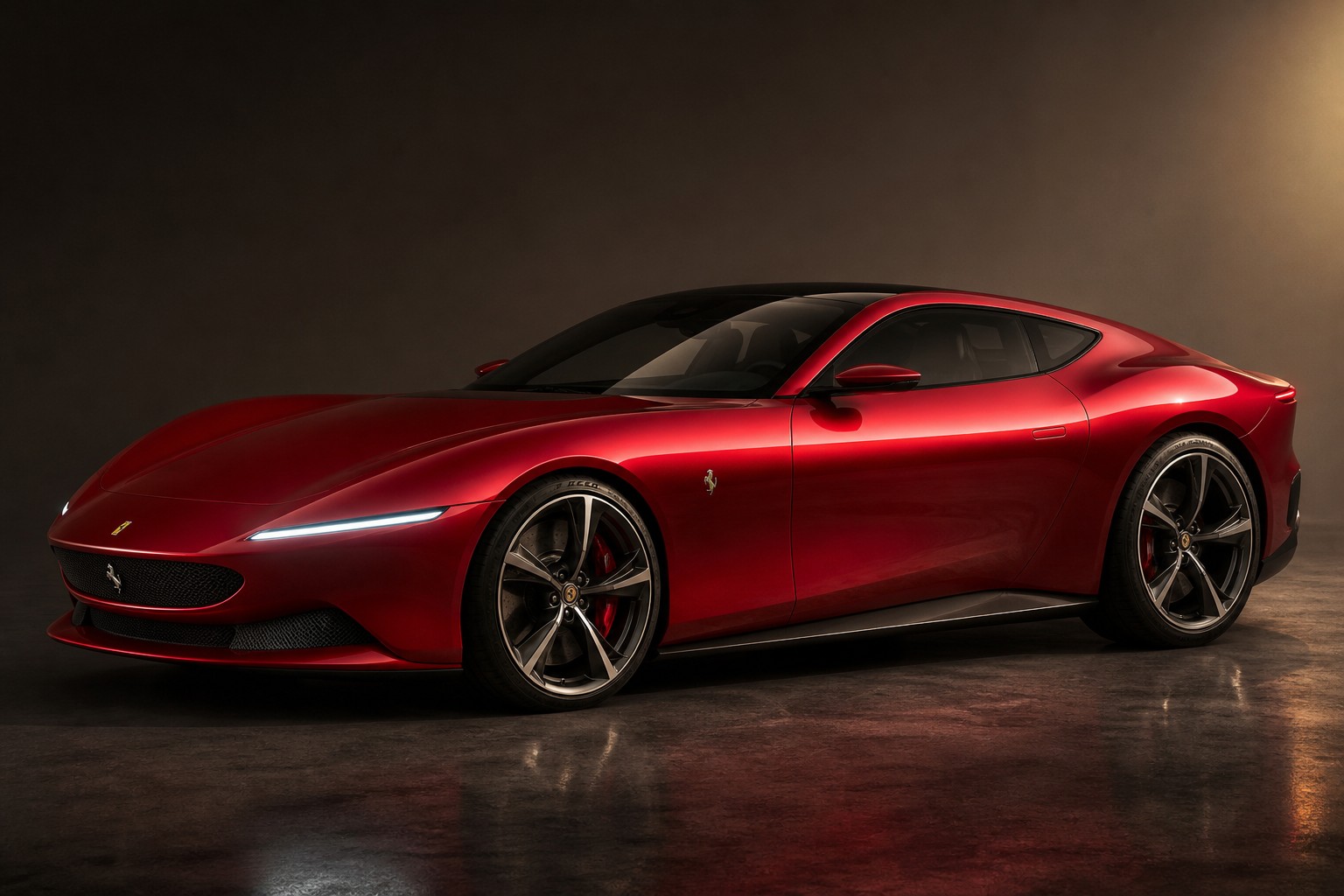
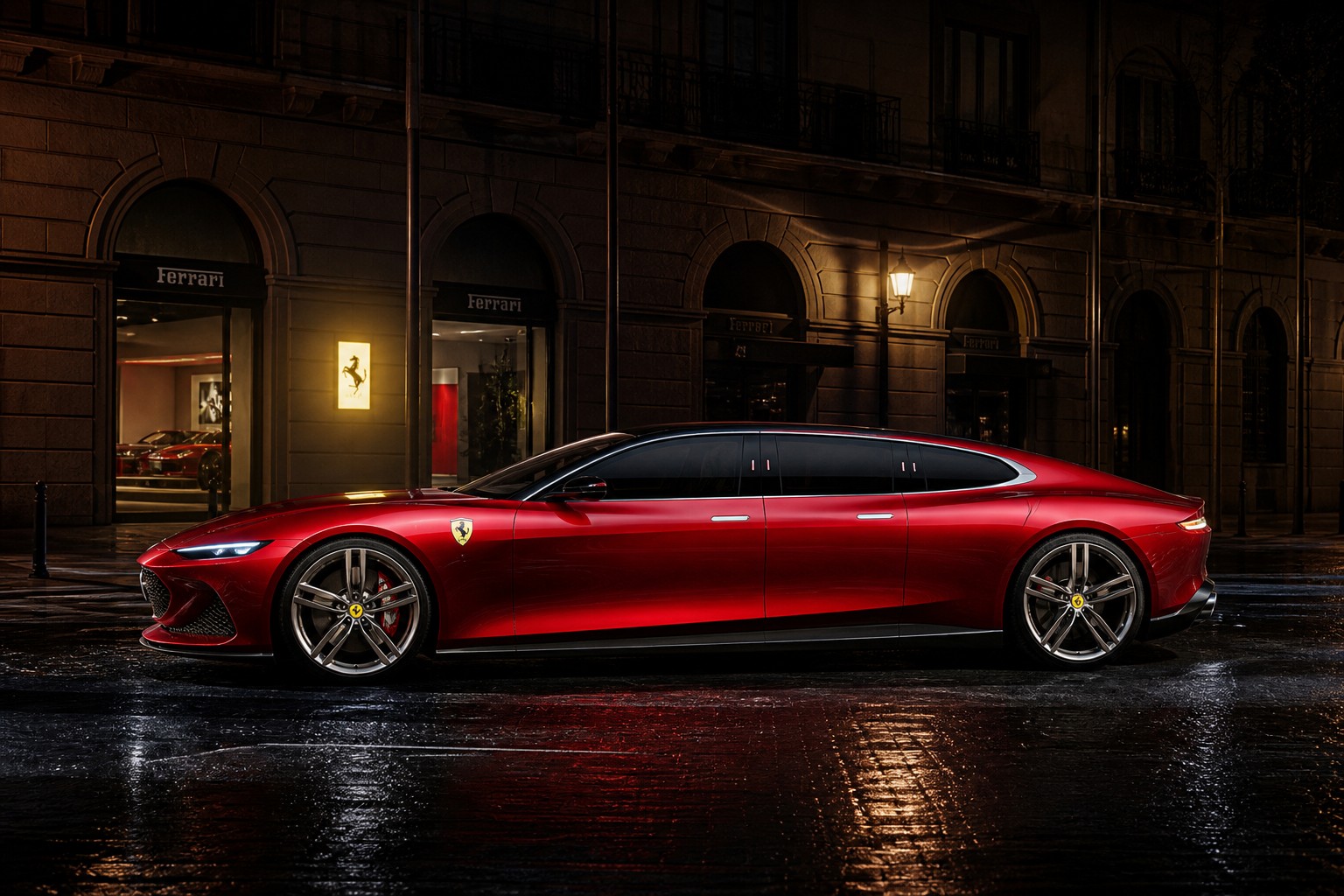
The internet answered the same way within days of the reveal. Independent designers and studios published alternate Luces that kept the electric package and returned the animal silhouette. Those renders matter because they prove the problem was never packaging. It was taste.
Ewoud Luppens, known online through car.design.trends, released an unofficial electric Ferrari sedan called Fioritura almost as Luce arrived. The concept mixes limousine length with a long hood and broader, more traditional Ferrari themes. It is not subtle. It is also more willing to have a personality than the production car.
Carwow’s redesign kept the five-seat four-door fastback, the circular rear lights that nod to the 360 and 458, and the side vents, then lowered the stance, sharpened the arches, deepened the intakes, and built a more aggressive diffuser. The brief stayed. The muscle returned.
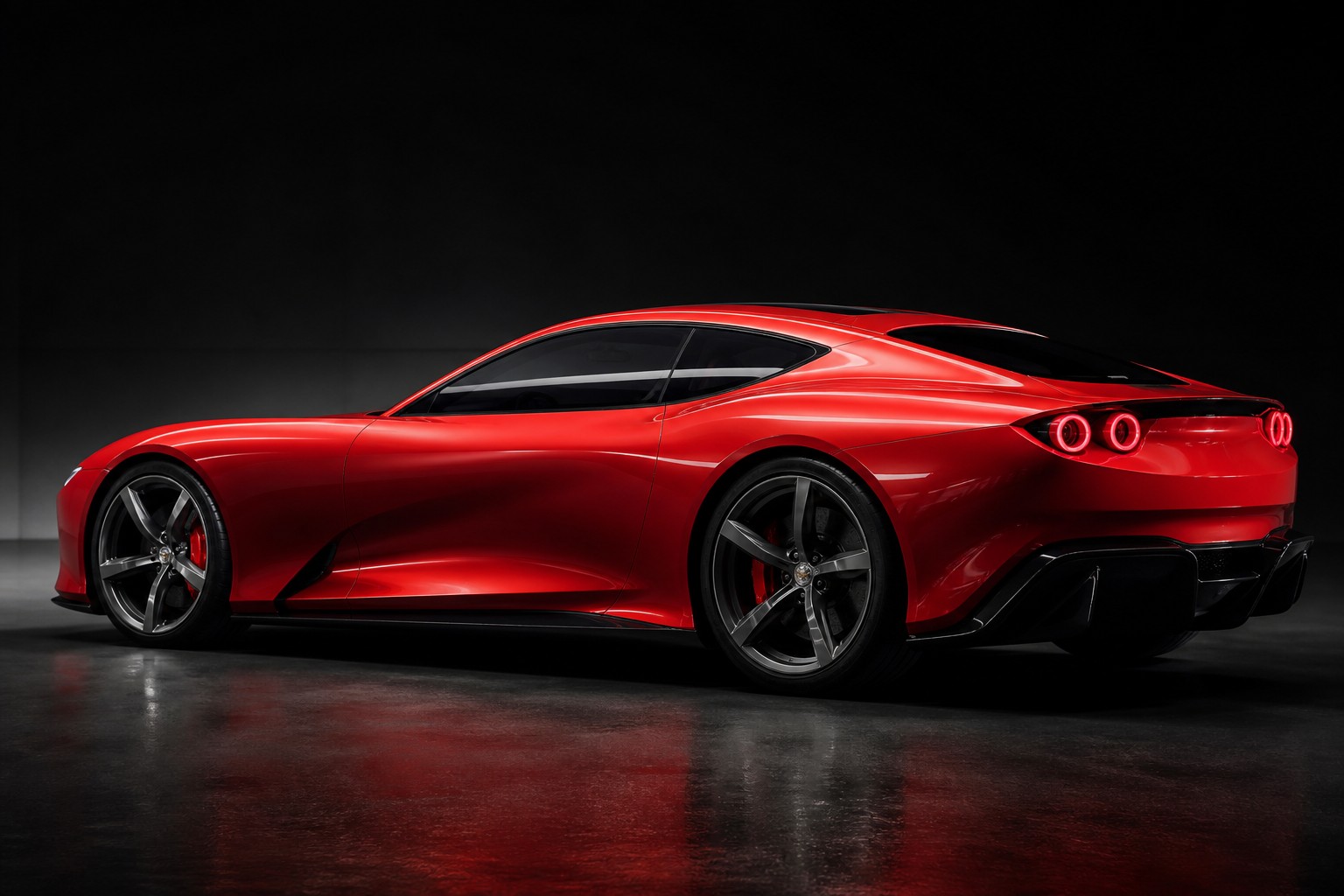
Instagram designer sugardesign_1, as covered by Autodevot, attacked the core failure of proportion. Longer nose. Lower roof. Tighter waist. The argument is blunt. Floor batteries did not stop Taycan or Xiaomi SU7 from looking planted. At €550,000, a raised potato is a choice, not a law of physics.
Before the exterior even landed, digital artist Andrei Avarvarii had already drawn a different future. A low 1980s-flavored electric sedan. Shark nose. Slim light strips. Star wheels. Flowing sides. It leaned on Testarossa and F40 memory without becoming a costume. That is the other path Ferrari could have taken. Not Cupertino purity. Italian geometry with blood still in it.
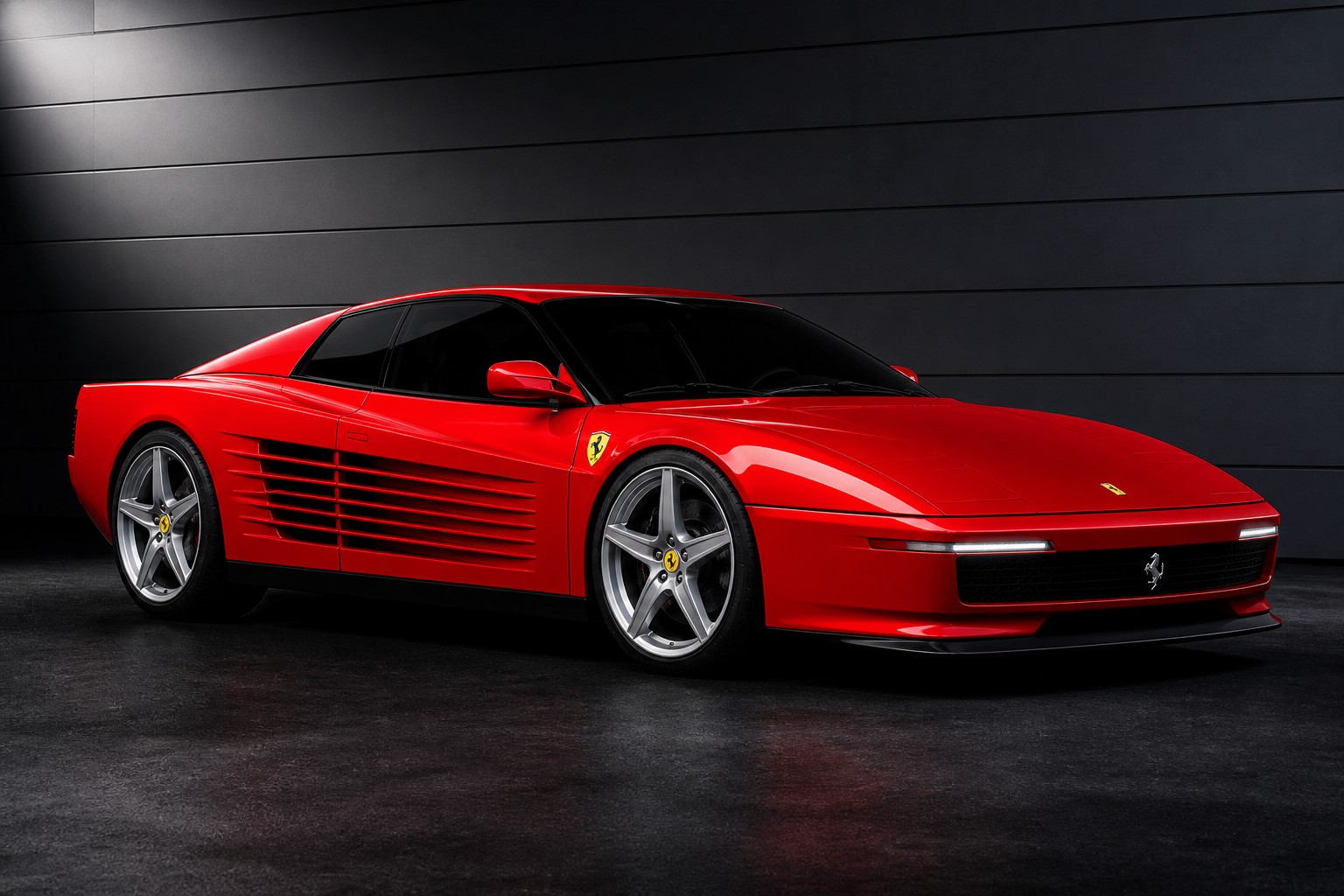
None of these images are official. That is the point. Within weeks of the unveil, outside pencils produced cars that still felt like Ferrari while accepting doors, seats, and batteries. LoveFrom produced coherence. The street produced desire. One of those outcomes matches the brand contract written in Modena since 1947.
That car could still be a five-seater. It could still charge at 350 kW. It could still have physical switches. What it would not do is ask Maranello to speak Cupertino. Electrification was always going to force a new package. It did not require a new species.
The tragedy of Luce is not that Ferrari went electric. It is that, at the exact moment the brand needed to prove battery cars can still seduce, it outsourced seduction to people whose genius is making desire disappear into calm.
Ferrari can survive a hated car. What it cannot survive forever is teaching the next generation that the prancing horse stands for polished inevitability. Curves were never decoration. They were the product.
So I will leave you with a simpler question than horsepower charts. When you buy a car, what do you operate on first? Specs, price, range, resale. Or the image that hits you before the brochure opens. And what do you call your car when nobody is listening. My brother, for example, calls his Lastochka, the Swallow. That one word already tells you more than a spreadsheet. It tells you the machine has entered his life as something alive.
Also on Medium.
Sources
Primary reporting and specs draw on the official Ferrari Luce pages, the Ferrari Luce entry on Wikipedia, and contemporaneous coverage from Car and Driver and Reuters after the May 2026 unveil. The RACE chart uses Yahoo Finance daily closes, with the Milan session move reported by Reuters. Recovery context draws on contemporaneous analyst notes from RBC and Citi after the unveil, Ferrari’s later guidance raise after a second-quarter beat, and CNBC reporting on the post-slump rebound and a roughly $40 million charity sale of a bespoke Luce. Design and reception context comes from Dezeen’s LoveFrom report, including the podcast asking why so many people hated the car, as well as The Guardian’s market reaction piece and Designboom’s reveal coverage. Alternate-design references include MotorExclusive on the Fioritura concept by Ewoud Luppens, Carwow’s Luce redesign, Autodevot on sugardesign_1, and Avarvarii’s pre-reveal renders. Enzo’s temperament and the “not like a woman” line appear in The New Yorker’s 1966 profile “The Terrible Joys.” The desire metaphor and coachbuilding oral history run through Montezemolo interviews and Scaglietti-era accounts. The custody of Ferrari form and the meaning of red draw on Pininfarina and Centro Stile history, the rosso corsa national racing-color tradition, and Ferrari’s own magazine essay Does Rosso Ferrari exist? Film sources are the official Ferrari Luce Inside the Story series and the full reveal on YouTube.