Overview
At Timeweb the hosting business was stable, but growth needed a new category: not another control panel, a place where creating a site and hosting it are one continuous flow. That product became Craftum (craftum.com / craftum.com), built on top of Timeweb Cloud infrastructure.
My role covered end-to-end product design: problem framing with PM and eng, editor UX, design system for 150+ templates and 200+ blocks, and the publish path that made SSL, CDN, and domains feel invisible.
The real problem was not “no templates”
We kept hearing the same three words in interviews: fear, complexity, fragmentation.
Someone has an idea. Then the gauntlet: pick hosting, buy a domain, wire DNS, install a CMS, fight SSL, hope the template does not break on mobile. Each step is a drop-off. Competitors that win on aesthetics (Webflow, Tilda, Framer) still often hand the user back to “infra land” at publish time.
Timeweb already owned the missing piece: cloud hosting, CDN, and domain tooling. The bet was simple: if the editor and the infrastructure share one mental model, first publish stops feeling like a technical exam.
Research signal we designed around
Across CIS and EU no-code research, most builders optimized for looking good. Almost none closed the loop to a hosted, SSL-ready site without a second product.
- Empty-canvas anxiety. Blank editor = instant regret. People wanted a “good enough” structure in under a minute, then permission to edit.
- Publish as a cliff. Users finished the layout, then stalled on domains, certificates, and “where does this live?”
- Block overload. Huge libraries without hierarchy made assembly slower, not faster. Discoverability beat raw count.
- Trust in the host. SMB users cared less about fancy motion and more about “will this stay up and load on 4G?”
Working hypothesis: combine a visual builder with Timeweb hosting, and users launch sites 3–5× faster, with higher 30-day retention from ecosystem trust.
Product concept: Create → Publish → Manage
Craftum was framed as a full-cycle web platform, not “export HTML and good luck”:
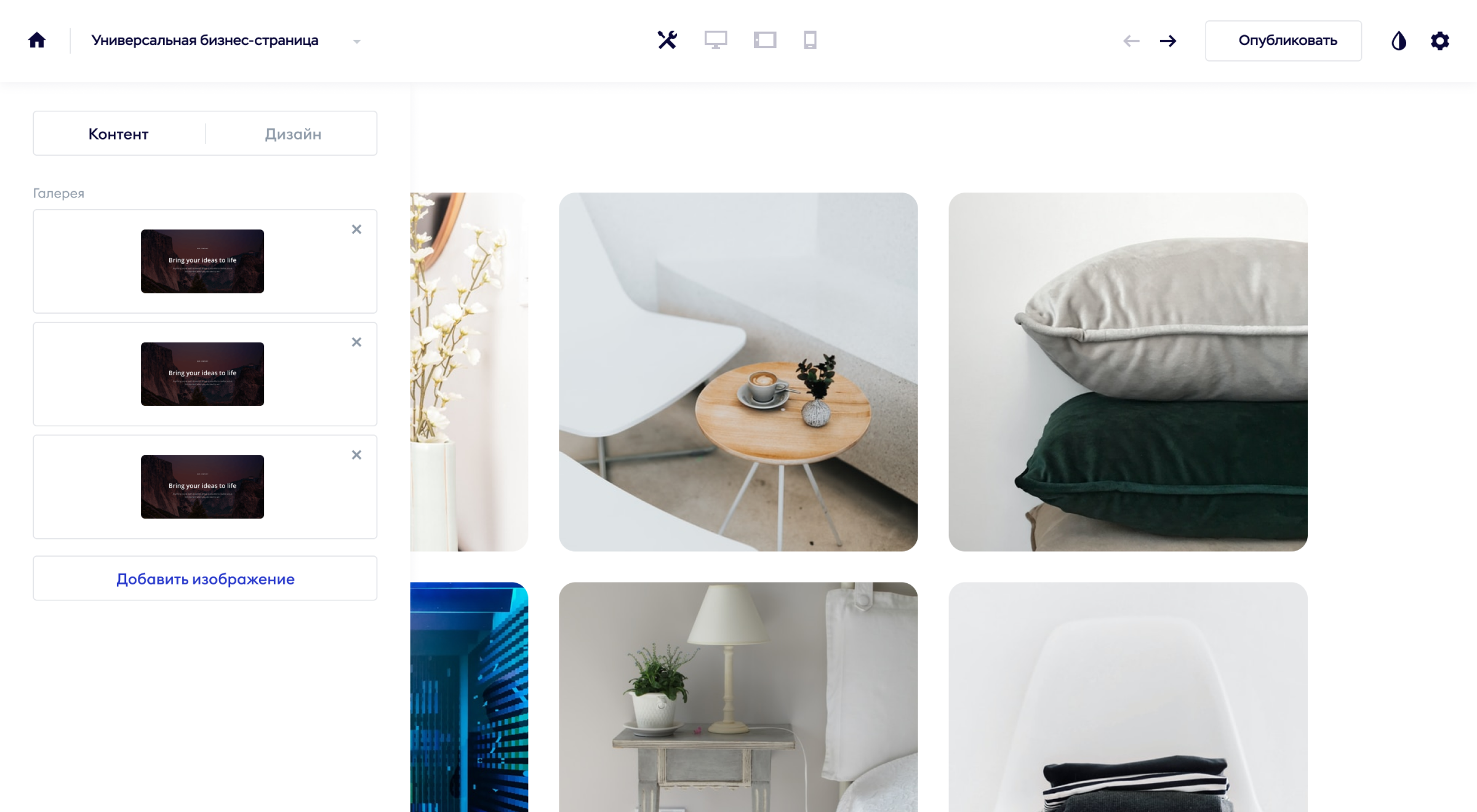
- Build on a live canvas with contextual editing (edit on the page, not only in side panels).
- Connect a domain in one flow, or start on a
craftum.sitesubdomain. - Publish into Timeweb infrastructure: SSL, CDN, and versioning without FTP theatre.
North-star moment: press Publish and the site is live. No waiting room for “ask your developer.”
UX principles that stuck
Every action earns visual feedback. Add a section, it appears. Change a type scale, see it. Publish, land on a real URL.
Drag-and-drop as conversation, not a gimmick. Insertion zones light up; blocks refuse impossible nests instead of silently breaking the grid.
Progressive power. Beginners start from templates; advanced users open design blocks, custom HTML/CSS/JS, SEO fields, and integrations (chat, payments, analytics) without leaving craftum.com.
We also treated onboarding as a product surface: a “first site in 15 minutes” path aligned with how Craftum sells today (template or 200+ blocks, then promote).
Design system: Lego for pages, not a sticker pack
I built the Craftum design system as a modular kit: tokens, type rhythm, shadows with semantic weight, and interchangeable sections that still respect one grid.
- Visual lightness so dense SMB pages do not feel like a brochure from 2012.
- Semantics through color and elevation instead of loud chrome.
- Living typography where hierarchy carries rhythm, not just contrast.
- Lego sections: swap hero, pricing, FAQ, store modules without restyling the whole page.
That system had to scale to what the live product ships: on the order of 150–240 templates and 170–220 blocks across plans, plus store and blog surfaces for teams that outgrow a single landing.
Later bets that match the live product
After the core loop worked, the roadmap leaned into acceleration. Craftum AI generates a structured landing with copy and stock imagery (Unsplash), then the user edits in the same canvas. That is not a side toy: it attacks empty-canvas anxiety with a shippable first draft in minutes.
Commerce followed the same philosophy: CSV import, large catalogs, and checkout integrations without forcing a separate “store CMS.” Pricing stayed aggressive (from about $8/month on long plans) so Craftum stayed in the “start today” bracket versus agency builds.
Outcomes
Within months of MVP, Craftum moved from an internal Timeweb experiment to its own product line. Public positioning today: 15,000+ clients, free hosting in the loop, and PageSpeed-oriented output as a trust signal for SMB owners.
Public Craftum footprint across SMB and creator sites.
Users who published stayed in the create–manage loop.
Retention lift versus classic hosting-only onboarding.
Faster path from signup to live URL vs fragmented stack.
| Metric | Signal | Why it mattered |
|---|---|---|
| Active websites | 15,000+ | Proof the closed loop scaled past MVP |
| Built-in hosting usage | High attach | Editor and infra felt like one product |
| Time to first publication | Minutes, not days | Removed DNS/SSL theatre from critical path |
| 30-day retention | 58% | Trust compound: site lives where it was built |
| vs classic hosting | +37 pts | New growth category for Timeweb, not a skin |
What I would still double down on
Craftum taught a hosting company that infrastructure wins when it disappears. The design job was not “prettier blocks.” It was making Create → Publish → Manage feel inevitable.
- Ship the emotional win (live URL) before teaching advanced layout power.
- Design systems for no-code must optimize discovery and safe composition, not only token purity.
- AI generation only helps if output lands in the same editor grammar as hand-built pages.
- Retention follows ownership of the runtime: when hosting is native, churn talks to product, not to DNS.
Live product: craftum.com. Infrastructure backbone: Timeweb Cloud.